Indica vs. Sativa vs. Hybrid: What Actually Matters (Hint: Terpenes)
The indica/sativa/hybrid system doesn't predict your experience. Terpenes do. Here's why the labels are misleading, what science actually shows, and how to shop for cannabis based on chemistry instead of outdated categories.
Questions this article answers
- indica vs sativa what is the difference
- does indica vs sativa matter
- what determines cannabis effects
- are indica and sativa real categories
- why do indicas make you tired

Head Cultivator
On this page
Walk into any dispensary and you'll see the menu organized by indica, sativa, and hybrid. Here's the problem: science has known for nearly a decade that this system doesn't work. A landmark 2021 study in Nature Plants found that cannabis samples labeled indica or sativa were basically the same plant, genetically speaking. The German research group analyzing 140 medical strains in 2025 found no connection between terpene profiles and sativa/indica labels. What actually determines your experience isn't whether the plant grew short and bushy or tall and thin — it's the terpenes, the aromatic oils that shape how THC and CBD interact with your body. This is your no-nonsense guide to understanding what actually matters when choosing cannabis.
Where Did the Indica/Sativa Myth Come From? #
The indica/sativa distinction began as an observation about how the plant looks and grows, not a prediction of effects. European naturalists in the 18th century categorized cannabis by physical characteristics — height, leaf shape, and origin — with no claims about how the plant would make you feel. In the 18th century, European naturalists categorized cannabis plants by their physical characteristics:
| Characteristic | Cannabis indica | Cannabis sativa |
|---|---|---|
| Height | Short, bushy (2-4 feet) | Tall, lanky (6-12+ feet) |
| Leaves | Broad, wide leaflets | Narrow, thin leaflets |
| Flowering time | 6-8 weeks | 10-16 weeks |
| Origins | Hindu Kush mountains (Afghanistan, Pakistan, India) | Equatorial regions (Mexico, Thailand, Colombia) |
| Climate adaptation | Cool, short growing seasons | Warm, long growing seasons |
These were agricultural categories — how the plant grows, not what it does to you. The indica/sativa distinction made sense for farmers deciding what to plant. It made no claims about effects.
How "Growing Characteristic" Became "Experience Prediction" #
The shift from plant structure categories to effects marketing happened gradually through the 1970s-1990s counterculture. Dispensaries needed simple ways to guide consumers, and "indica = in-da-couch, sativa = energetic" became the shorthand. The problem: this shorthand wasn't based on chemistry. It was based on pattern recognition from a limited sample of strains during an era when:
- Most "indicas" happened to contain myrcene (a relaxing, sleepy terpene)
- Most "sativas" happened to contain limonene (a mood-lifting terpene)
- The connection was accidental, not cause-and-effect
When breeders began crossing everything with everything, the genetic differences between indica and sativa faded away — but the marketing categories stuck around.
What Does Science Actually Say About Indica vs Sativa? #
Modern genetic testing shows indica and sativa labels have no connection to chemical makeup or effects. Multiple peer-reviewed studies confirm that how the plant looks does not predict terpene content, THC-to-CBD ratios, or user experience.
The 2021 *Nature Plants* Study #
Researchers analyzed hundreds of cannabis samples labeled as indica or sativa. Their findings:
- No genetic distinction: Samples labeled indica and sativa were basically the same plant, genetically speaking
- THC/CBD levels unrelated to label: THC, CBD, and CBG levels showed no connection to indica/sativa classification
- Myrcene was the only real difference: Myrcene levels alone explained more than 21% of the variation between labeled indica and sativa samples
Translation: The only thing making "indicas" sedating was that many happened to contain myrcene — that earthy, mango-smelling terpene that makes you relaxed and sleepy. The plant's physical structure (short vs. tall) had nothing to do with it.
The 2025 German Chemovar Study #
A comprehensive analysis of 140 medicinal cannabis strains using advanced lab testing found:
- No connection between terpene profiles and sativa/indica labels
- 9 terpenes explained 86% of chemical variation in the sample — and none of those 9 tracked with indica/sativa labels
- Chemical diversity within categories: Strains labeled as the same category (indica, sativa, hybrid) showed huge chemical variation
The 2022 Commercial Sample Analysis #
Researchers analyzing 89,923 commercial cannabis samples concluded: "Commercial labels do not consistently align with the observed chemical diversity." In plain language: the indica/sativa/hybrid labels on dispensary menus don't reliably show what's actually in the jar.
Why Do Dispensaries Still Use Indica/Sativa Labels? #
Dispensaries continue using indica/sativa labels because they're familiar to consumers, not because they're scientifically accurate. Marketing inertia, consumer expectations, and the simplicity of "indica for sleep, sativa for energy" keep outdated categories alive despite research proving they don't work.
The Marketing Incentive #
Simple categories sell products. "Indica for sleep, sativa for energy" is easier to explain than "look for myrcene as the main terpene with linalool as secondary, avoid pinene if you get too wired from it." Dispensaries serve customers who want quick guidance, and the old categories provide that — even if they're wrong.
The Genetic Reality #
Pure indica and pure sativa varieties are now extremely rare. Decades of cross-breeding mean:
- 85.7% of strains in major databases are hybrids
- Most "indicas" contain sativa genetics
- Most "sativas" contain indica genetics
- The categories have become meaningless even for plant identification
Consumer Expectation #
Many consumers have learned the indica/sativa system and expect to see it. Changing the classification system requires consumer education that most retailers aren't equipped to provide. The result: outdated categories persist because they're familiar, not because they're accurate.
What Actually Determines Your Cannabis Experience? #
Terpenes — the aromatic oils in cannabis — determine your experience, not indica/sativa labels. These natural plant oils change how THC and CBD interact with your body's receptors, creating the specific effects you feel.
How Terpenes Work #
Terpenes are natural plant oils that give off a smell — produced by cannabis (and thousands of other plants). In cannabis, they serve several functions:
- Aroma and flavor — what makes each strain smell unique
- Defense — repelling bugs and attracting pollinating insects in the wild
- Changing how cannabis works — affecting how THC and CBD interact with your body's receptors and the chemical messengers in your brain
The last function is what matters for effects. Terpenes don't just smell good — they actively change how THC and CBD interact with your body, including your endocannabinoid system (your body's cannabis receptors), mood-regulating system, calming system, and other targets.
The Major Terpenes and Their Effects #
| Terpene | Aroma | Primary Effects | Where It's Common |
|---|---|---|---|
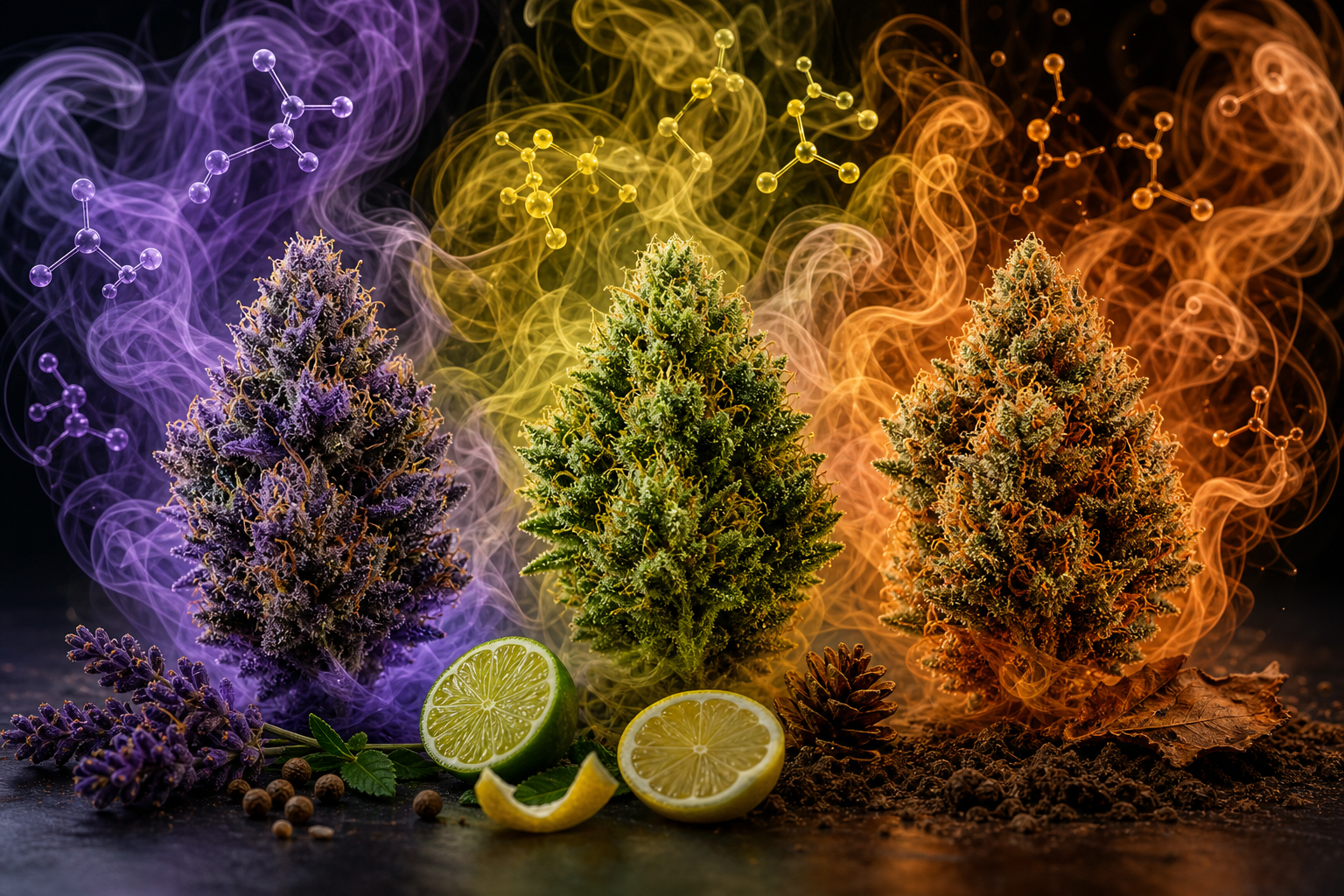
| Myrcene — that earthy, mango smell that makes you relaxed and sleepy | Earthy, musky, mango | Sleepiness, muscle relaxation, reduces swelling | "Indica" strains, mango, hops |
| Limonene — the citrus smell that lifts your mood | Citrus, lemon | Mood elevation, stress relief, reduces anxiety | "Sativa" strains, citrus rinds |
| Terpinolene — the piney, herbal smell that perks you up | Piney, floral, herbal | Uplifting, energizing, focus | "Sativa" strains, tea tree, nutmeg |
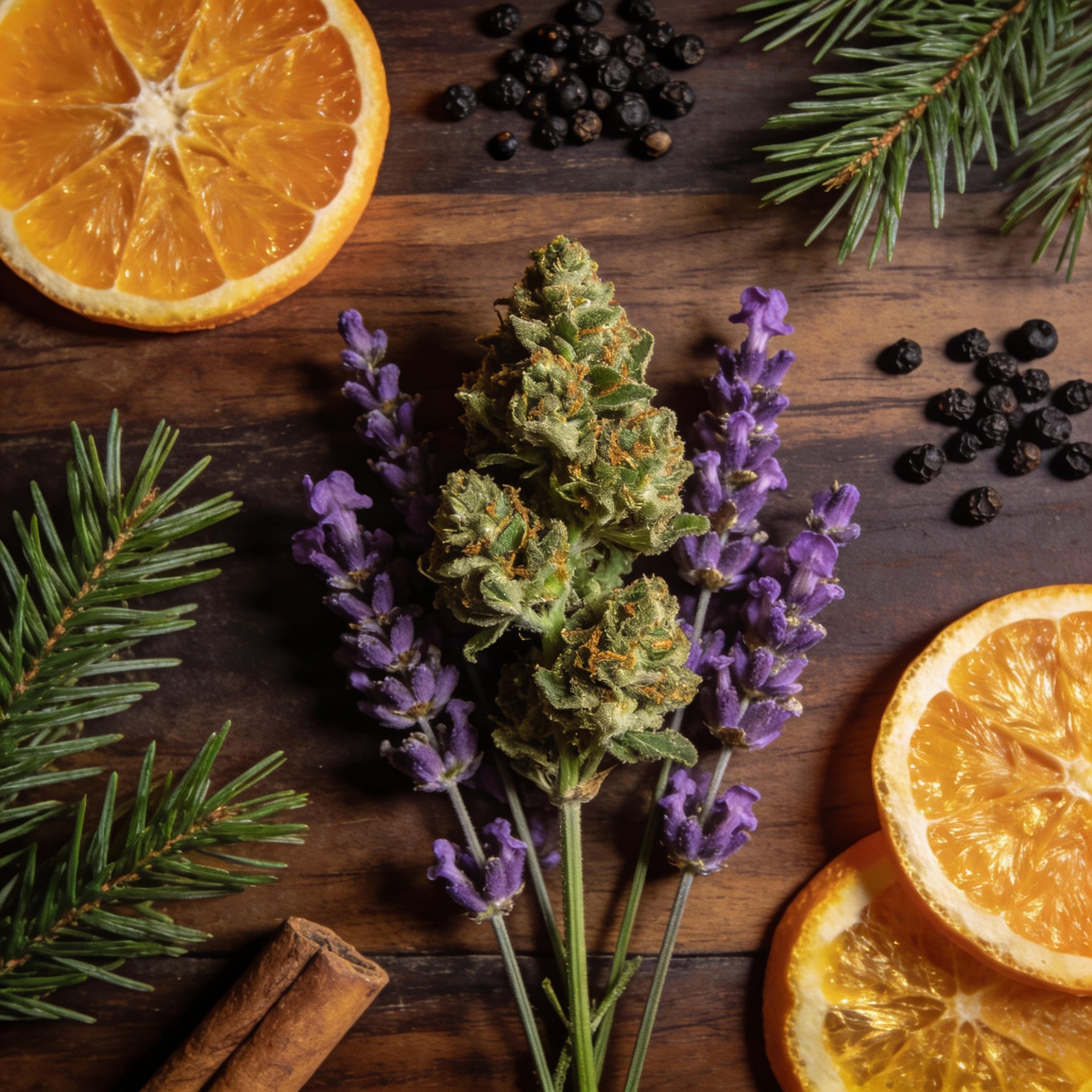
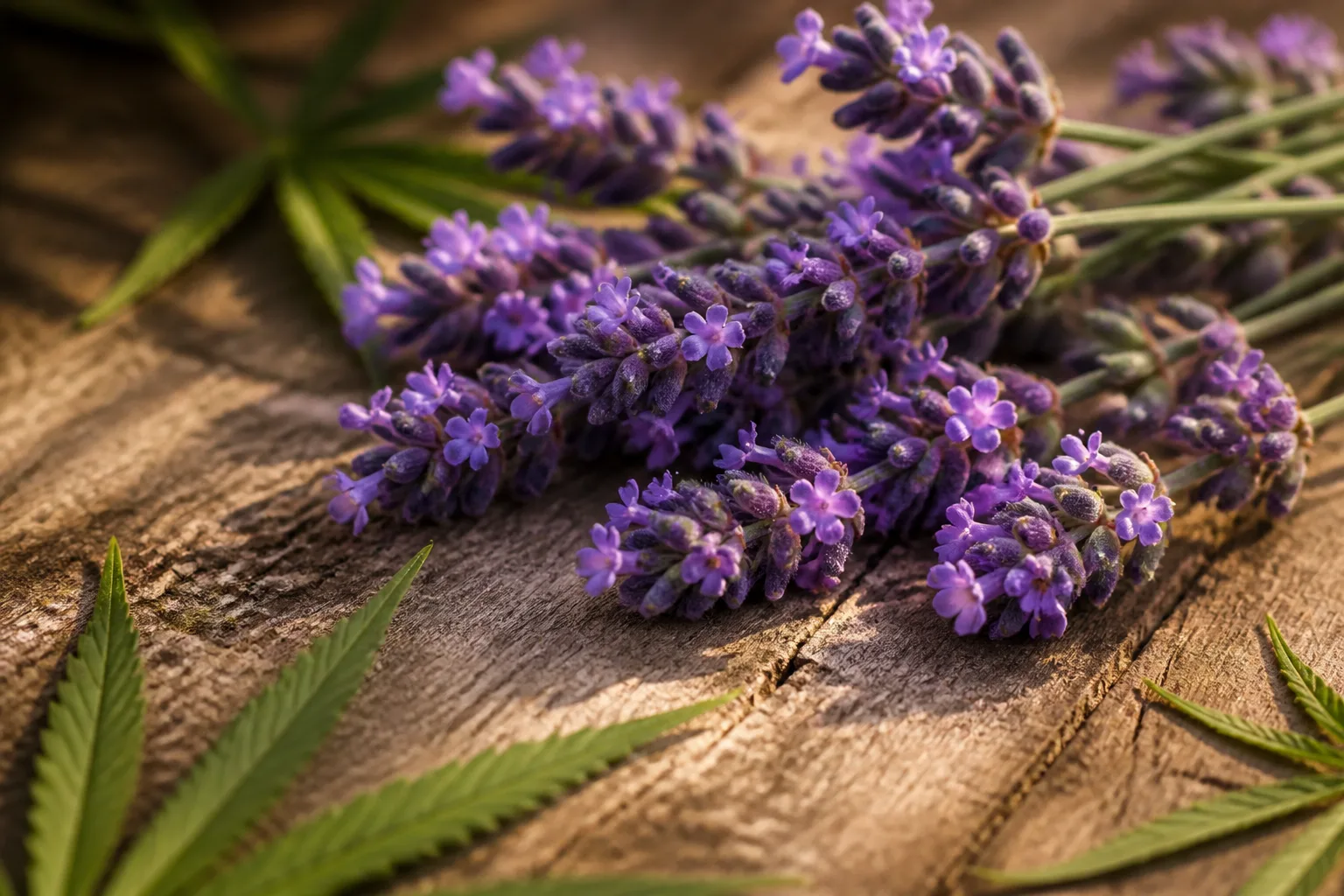
| Linalool — the floral, lavender smell that calms you down | Floral, lavender | Calming, reduces anxiety, helps sleep | Many strains, lavender |
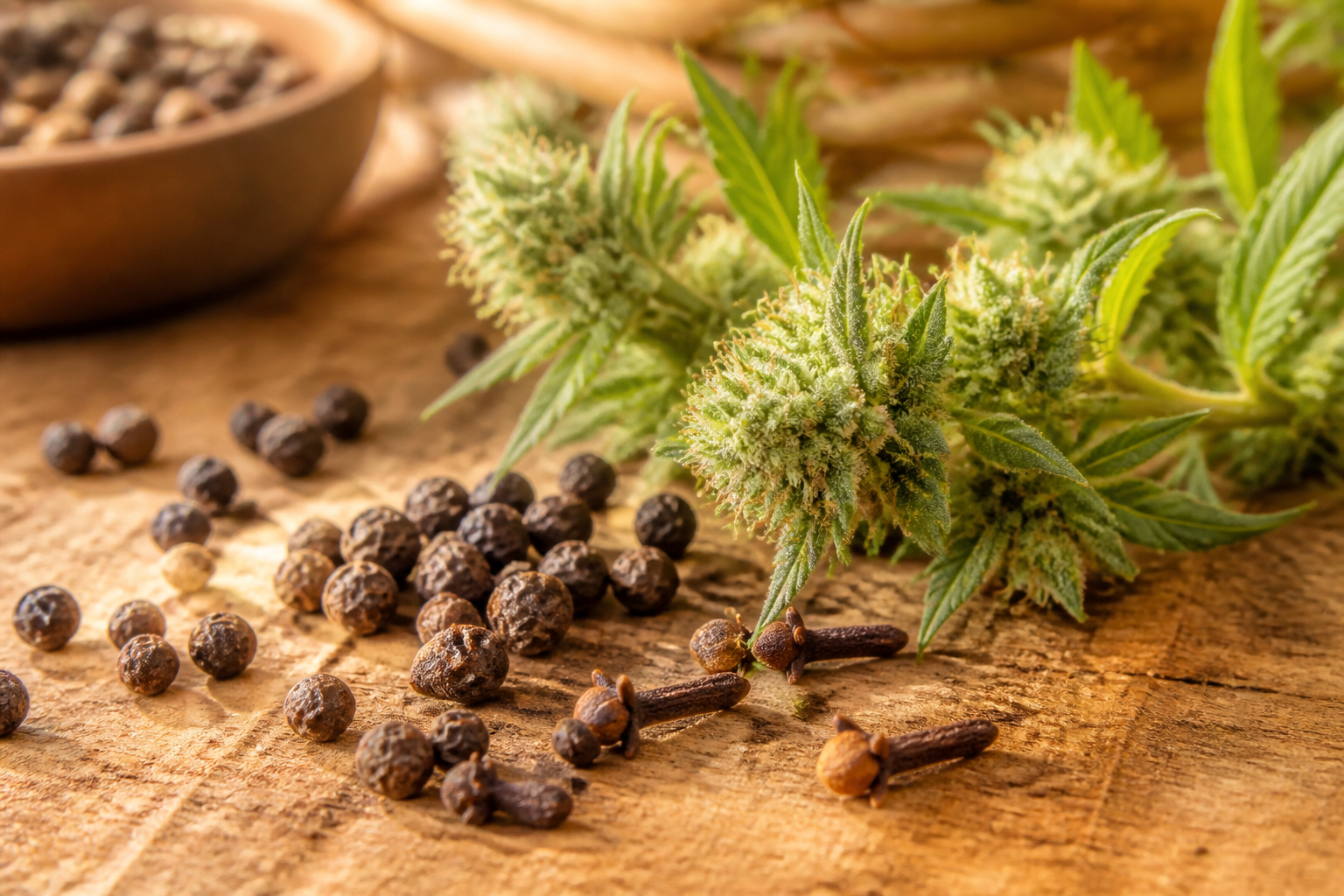
| Beta-caryophyllene — the peppery, spicy smell that helps with pain | Peppery, woody | Stress relief, reduces swelling, pain reduction | Many strains, black pepper |
| Pinene — the pine smell that keeps you alert and opens your airways | Pine | Alertness, memory support, opens up your airways | Pine trees, rosemary |
| Humulene — the hoppy, earthy smell that curbs appetite | Hoppy, earthy | Appetite suppression, reduces swelling | Hops, coriander |
The Entourage Effect: Why Terpenes Matter More Than THC Alone #
The entourage effect is just a fancy way of saying that terpenes and THC, CBD, and other cannabis compounds work together to produce effects that neither achieves alone. Research consistently shows:
- Myrcene + THC produces more sleepiness and relaxation than THC alone
- Limonene + THC produces more mood lift with less anxiety
- Beta-caryophyllene + CBD produces stronger effects for reducing swelling
- Linalool + THC reduces the anxiety that THC can cause at higher doses
This is why two strains with identical THC percentages can produce completely different experiences. A 20% THC strain dominant in myrcene and linalool feels sedating and calming. A 20% THC strain dominant in limonene and pinene feels energizing and heady.
How Should You Shop for Cannabis If Indica/Sativa Doesn't Work? #
Shop by terpene chemistry instead of indica/sativa labels for predictable, consistent effects. Reading Certificates of Analysis, matching terpenes to your goals, and trusting lab data over marketing categories will transform your cannabis experience.
Step 1: Read the Terpene Panel (Not Just the THC Percentage) #
A proper Certificate of Analysis (COA) from a licensed lab shows:
- THC and CBD percentages
- All detected terpenes with percentages
- Total terpene content
Look for:
- Total terpenes above 1.5% — below this, the profile is likely degraded or poorly grown
- Dominant terpene at 0.4%+ — this is the primary driver of effects
- Secondary terpenes that complement your goal
Step 2: Match Terpenes to Your Goal #
| Your Goal | Look For | Avoid |
|---|---|---|
| Sleep | Myrcene dominant, linalool present | Pinene, limonene dominant |
| Energy/Focus | Limonene, terpinolene, pinene | Myrcene dominant |
| Pain relief | Beta-caryophyllene, myrcene, linalool | High pinene |
| Anxiety relief | Linalool, beta-caryophyllene, limonene | High THC without CBD |
| Social/creative | Limonene, terpinolene, moderate myrcene | Heavy myrcene |
Step 3: Ignore the Indica/Sativa Label #
Treat indica/sativa as historical trivia, not buying guidance. A "sativa" with 0.8% myrcene will make you sleepy. An "indica" with 0.3% myrcene and 0.4% limonene will feel energizing. The terpenes are the signal; the category is noise.
Step 4: Trust Your Nose (With Caveats) #
Your nose detects terpenes. If a strain smells like:
- Mango/earthy/dank → likely myrcene dominant (sedating)
- Lemon/citrus → likely limonene dominant (energizing)
- Pine/forest → likely pinene dominant (keeps you alert)
- Pepper/spice → likely beta-caryophyllene (pain/anxiety relief)
- Floral/lavender → likely linalool (calming)
Caveat: Smell alone doesn't indicate potency or quality. A strong-smelling strain isn't necessarily stronger — just more aromatic. And some excellent strains have subtle terpene profiles that don't hit you in the face.
What Happens When Strains Defy Their Labels? #
Real-world examples prove indica/sativa labels fail to predict effects — the same category can produce opposite experiences. Two "indicas" can feel completely different based on their terpene profiles, rendering the categories meaningless.
The "Indica" That Feels Like a Sativa #
Strain type: Marketed as indica Terpene profile: 0.3% myrcene, 0.5% limonene, 0.2% pinene Actual effect: Uplifting, energizing, head-clearing Why: Low myrcene means minimal sleepiness; limonene and pinene keep you alert
This happens frequently with strains like certain OG Kush varieties — physically indica-leaning in structure but chemically diverse enough to produce variable effects.
The "Sativa" That Knocks You Out #
Strain type: Marketed as sativa Terpene profile: 0.7% myrcene, 0.1% limonene, 0.2% linalool Actual effect: Sedating, couch-lock, heavy Why: High myrcene dominates; minimal energizing terpenes present
This occurs with strains like certain Diesel crosses that look like sativas but produce indica-like terpenes.
What's the Lesson? #
The label provides zero predictive value — only terpenes matter. The same dispensary might stock two strains labeled "indica" that produce opposite effects, and two labeled "sativa" that feel completely different. Divine Toke's Detroit cultivation facility produces strains with transparent terpene profiles so you know exactly what you're getting, regardless of what category the plant structure suggests.
Why Does Sun-Grown Cannabis Have Better Terpene Profiles? #
Sun-grown outdoor cannabis consistently delivers 2-3x higher terpene diversity and total terpene content than indoor-grown. UV rays from natural sunlight trigger the plant's defensive terpene production in ways artificial lighting cannot replicate.
At Divine Toke, our Detroit-based cultivation facility specializes in sun-grown organic cannabis using living soil and natural growing methods. This approach produces stronger terpene profiles that indoor operations simply cannot match.
The Sun-Grown Advantage #
Sun-grown outdoor cannabis consistently shows:
- 2-3x higher terpene diversity than indoor water-grown
- More complex profiles with 20+ terpenes often present
- Better preservation of aromatic oils when properly cured
- Higher total terpene content (often 2-4% vs. 0.8-1.5% for indoor)
Why? UV rays from natural sunlight trigger the plant's defensive terpene production. Indoor lighting is optimized for plant size and yield, not the chemical changes the plant makes in response to sunlight (defensive compound production). The result: sun-grown plants invest more energy in the aromatic oils that matter for effects.
Indoor vs. Outdoor Terpene Comparison #
| Factor | Indoor/Controlled | Sun-Grown Outdoor |
|---|---|---|
| Total terpenes | 0.8-1.5% typical | 2-4% common |
| Terpene diversity | 8-12 compounds typical | 15-25 compounds common |
| Profile consistency | High (controlled environment) | Natural variation (weather dependent) |
| Shelf stability | Often degrades faster | Properly cured, lasts well |
This doesn't mean all indoor is bad or all outdoor is good. But if you're shopping by terpenes for specific effects, sun-grown organic cannabis offers the richest, most complex profiles.
What's the Future of Cannabis Classification? #
The industry is moving toward sorting cannabis by what's actually in it, not what it looks like. This shift will replace indica/sativa labels with terpene-dominant categories and effect-based groupings. Here's what's emerging:
Chemovar Classification #
Rather than indica/sativa, researchers propose organizing cannabis by its chemical profile:
- THC-dominant vs. balanced vs. CBD-dominant (ratio of these main compounds)
- Terpene-dominant categories (myrcene-dominant, limonene-dominant, etc.)
- Effect-based groupings (sleepy, energizing, balanced, etc.)
This is how the medical cannabis industry in Germany and Australia already operates. Products are labeled by their dominant terpenes and expected effects — not by arbitrary genetic categories.
Personalized Cannabis #
The ultimate goal is personalized recommendations based on:
- Your body's unique response to cannabis
- Your specific goals and conditions
- Your past response to specific terpene profiles
Apps and services are emerging that track your strain experiences and recommend new products based on terpene matching. Within 5-10 years, "indica/sativa" may be as obsolete as "snake oil" is for medicine.
FAQ: Indica, Sativa, and What Actually Matters #
Q: Is there a difference between indica and sativa? #
A: Botanically, indica and sativa refer to how the plant looks and grows — indica plants are short and bushy from mountain regions; sativa plants are tall and lanky from equatorial regions. But decades of cross-breeding have made pure indica and sativa extremely rare. More importantly, how the plant looks does not predict effects. The terpene profile determines your experience, not whether the plant grew short or tall.
Q: Why do indicas make you tired? #
A: "Indicas" don't inherently make you tired — myrcene does. Many strains labeled indica happen to be high in myrcene, which causes sleepiness and muscle relaxation. But an "indica" with low myrcene and high limonene can feel energizing. The effect comes from the terpene, not the category.
Q: Why do sativas give you energy? #
A: "Sativas" don't inherently provide energy — limonene and terpinolene do. Many strains labeled sativa happen to contain these mood-lifting, alertness-boosting terpenes. But a "sativa" with high myrcene and low limonene can feel sedating. Shop by terpenes, not by label.
Q: What are terpenes and why do they matter? #
A: Terpenes are aromatic oils produced by cannabis (and other plants) that determine smell, flavor, and — crucially — effects. Terpenes change how THC and CBD work in your body. Myrcene causes sleepiness, limonene lifts mood, linalool reduces anxiety, beta-caryophyllene helps with pain. Two strains with identical THC levels but different terpenes produce completely different experiences.
Q: How do I know what terpenes are in my cannabis? #
A: Ask your dispensary for the Certificate of Analysis (COA) or terpene panel. Licensed labs test for major terpenes. Look for total terpenes above 1.5% and identify the dominant terpene (usually 0.4%+). You can also use your nose: mango/earthy smell indicates myrcene; citrus indicates limonene; pine indicates pinene; pepper indicates beta-caryophyllene.
Q: Is hybrid a real category? #
A: "Hybrid" is technically accurate (most modern cannabis is cross-bred), but it's not useful for predicting effects. Since 85% of strains are hybrids, the label applies to nearly everything and predicts nothing. A hybrid could be myrcene-dominant (sedating) or limonene-dominant (energizing). The terpene profile matters; the "hybrid" label doesn't.
Q: Why do dispensaries still use indica/sativa labels? #
A: Dispensaries use indica/sativa because it's familiar to consumers and provides simple (if inaccurate) guidance. "Indica for sleep, sativa for energy" is easier to communicate than complex terpene education. The categories persist because of marketing inertia and consumer expectation, not because they work.
Q: Should I ignore strain names entirely? #
A: Strain names aren't entirely meaningless — they often indicate family history and can suggest likely terpene profiles. But names are less reliable than lab-tested terpene panels. A "Blue Dream" from one grower may have a completely different terpene profile than "Blue Dream" from another. Always verify with the COA, not just the name.
Q: What should I look for if I want help sleeping? #
A: Look for myrcene as the dominant terpene (0.5%+), linalool present (0.1%+), and minimal pinene and limonene. THC between 15-20% is typically sufficient for sleep; higher THC often causes next-day grogginess without improving sleep quality. Total terpenes above 2% indicates a strong profile.
Q: What should I look for if I want energy and focus? #
A: Look for limonene or terpinolene as dominant terpenes, pinene present, and myrcene below 0.3%. Moderate THC (15-20%) with some CBD (5-10%) often provides clearer energy than high-THC alone. Avoid heavy myrcene strains even if labeled "sativa."
Q: Does Divine Toke label products by indica/sativa? #
A: Divine Toke still prints indica/sativa/hybrid for familiarity, but the shop now shows the lab sheet: THC, CBD, and total terpenes on every flower card, and the top three terpenes on each product page. Ask for the November 2025 Steadfast numbers — or open the panel on the jar you want — instead of shopping by category.
At Divine Toke, Detroit's trusted source for sun-grown organic cannabis, we believe you deserve accurate information about what you're consuming. That's why we emphasize terpene testing and education over marketing categories that science has debunked. If you're curious about shopping by terpenes rather than indica/sativa labels, visit our shop and ask our team for a terpene recommendation based on what you're actually looking for — sleep, energy, pain relief, or just a pleasant evening.
Related Reading:
- What Are Terpenes? A Plain-Language Guide — deep dive into the aromatic oils that matter
- Minor Cannabinoids Explained — the other compounds beyond THC that shape your experience
- The Endocannabinoid System Deep Dive — the biology behind how cannabis works in your body
Grown in Detroit. Shipped to your door.
Small-batch, sun-grown cannabis cultivated in living soil. Mail-order shipping to all 50 states.