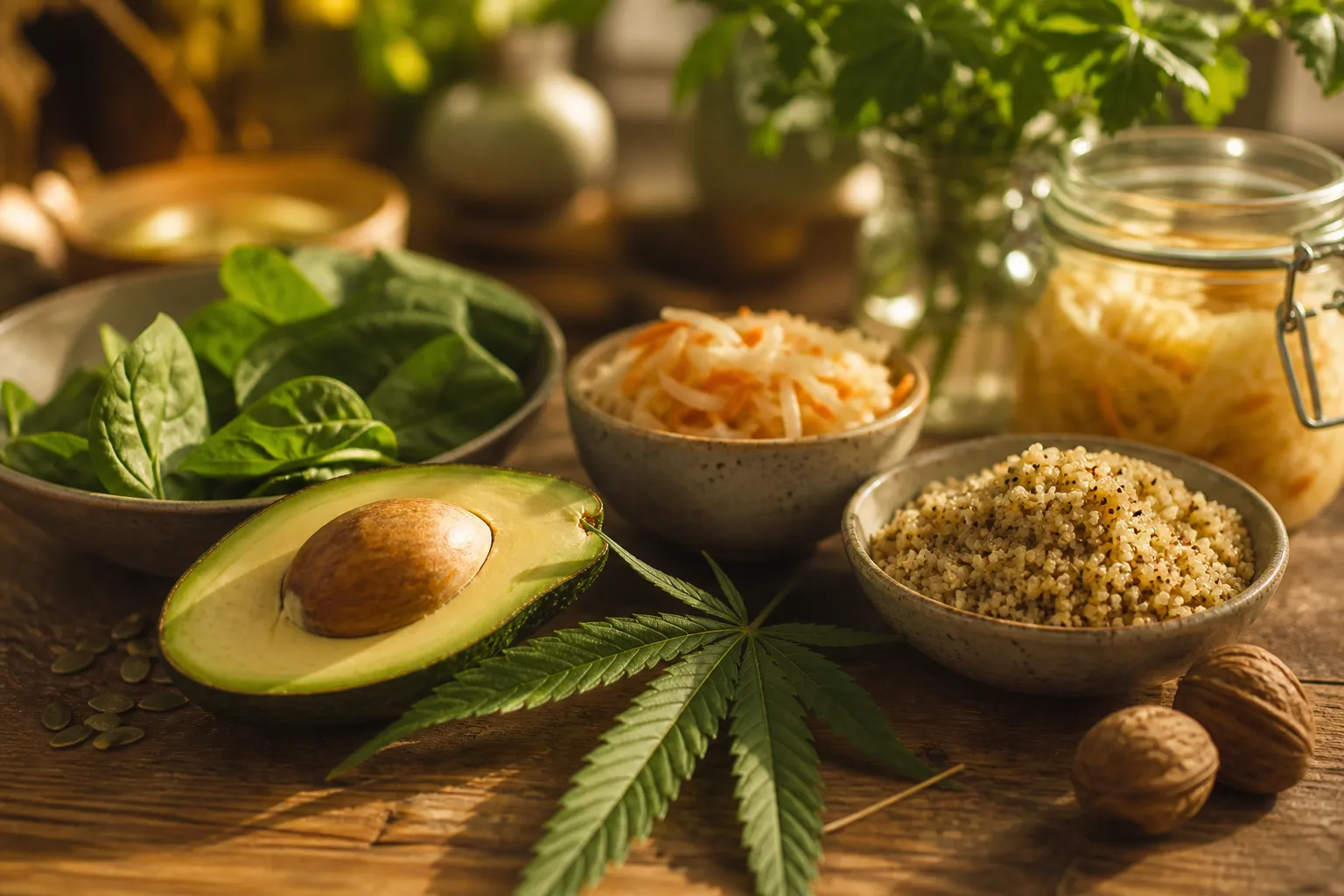
Strain Spotlight: Best Terpene Profiles for Digestive Comfort
Not all cannabis is equal for your gut. Learn which terpene profiles actually support digestion and which strains deliver them naturally.
Questions this article answers
- best cannabis strain for gut health
- which terpenes help with digestion
- what strain is best for Crohn's disease
- does beta-caryophyllene help IBS

Head Cultivator
On this page
If you're exploring cannabis for gut issues — whether that's IBS flare-ups, Crohn's symptoms, general cramping, or stress-related stomach problems — not all flower is created equal. The strain you choose matters. And more importantly, the terpene profile of that strain matters.
Terpenes are the aromatic compounds that give cannabis its smell and flavor. But they're not just about the nose. Research shows that specific terpenes interact directly with receptors in your gut, reduce inflammation, calm muscle spasms, and even influence how your gut talks to your brain.
This spotlight is aimed at Metro Detroit and Michigan shoppers who want to read a real label — not chase indica/sativa stickers. At Divine Toke, our sun-grown, organic flower naturally develops rich, complex terpene profiles that indoor factory grows can't match. Below: which terpenes to look for, why they matter for digestive comfort, which strain archetypes tend to carry them, and how Michigan COAs fit the shopping trip.
Table of Contents #
- Why Terpenes Matter More Than Strain Names
- The 5 Gut-Friendly Terpenes
- Strain Profiles for Digestive Comfort
- The Terpene-Cannabinoid Ratio Sweet Spot
- How Sun-Grown Cannabis Produces Better Terpenes for Gut Health
- How to Read a Lab Label for Gut-Friendly Terpenes
- Delivery Methods That Maximize Terpene Benefits
- FAQ: Terpenes and Digestive Health
- What to Try First
Why Terpenes Matter More Than Strain Names #
Here's a truth the industry is slowly catching up to: "indica" and "sativa" labels tell you almost nothing useful about how a strain will affect your body.
Those labels originally described plant structure (short and bushy vs. tall and lanky), not chemical effects. Two "indica" strains can have radically different terpene profiles — and therefore radically different effects on your gut.
What actually determines how cannabis affects your digestive system:
| Factor | What It Controls |
|---|---|
| Terpene profile | Inflammation response, muscle relaxation, gut motility, mood |
| THC:CBD ratio | Psychoactive intensity, anti-inflammatory balance, receptor targeting |
| Minor cannabinoids | CBG for inflammation, CBN for sedation, THCV for appetite modulation |
| Growing method | Terpene diversity and concentration (sun-grown > indoor) |
Bottom line: When shopping for digestive comfort, ignore the indica/sativa label. Read the terpene profile instead. If your Michigan dispensary doesn't provide terpene data on the jar or COA, ask — or find one that does. Licensed Detroit-area counters vary; the chemistry on the batch paperwork beats the nickname on the menu board.
The 5 Gut-Friendly Terpenes #
These are the terpenes backed by research for digestive support. Learn these, and you can walk into a Michigan dispensary and choose intelligently.
1. Beta-Caryophyllene (BCP) 🌶️ #
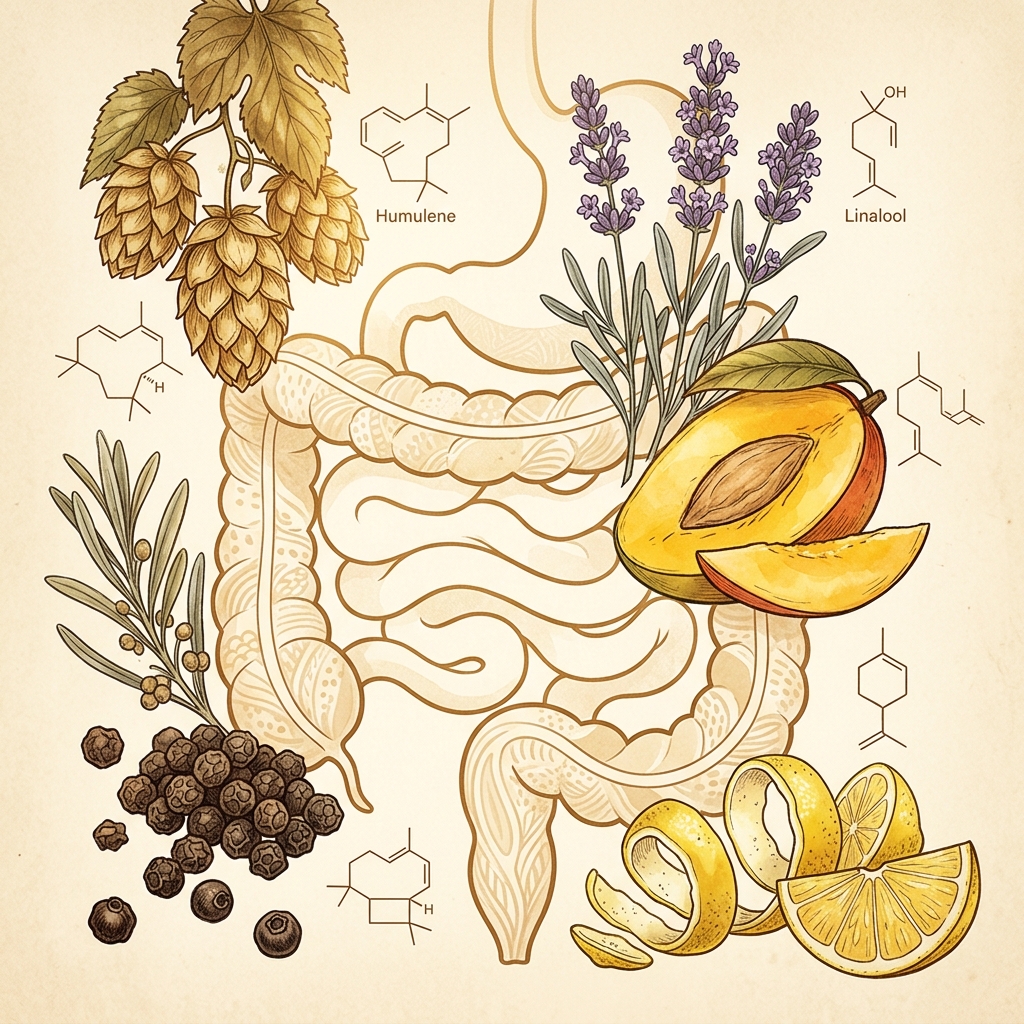
The most important terpene for gut health. Beta-caryophyllene is unique because it's the only terpene that directly binds to CB2 receptors — the immune-modulating cannabinoid receptors concentrated in your gut tissue.
| Property | Detail |
|---|---|
| Aroma | Peppery, spicy, clove-like |
| Also found in | Black pepper, cloves, cinnamon, oregano |
| Gut mechanism | Direct CB2 agonist → reduces intestinal inflammation, calms overactive immune response |
| Best for | Crohn's, ulcerative colitis, general gut inflammation |
When scientists call BCP a "dietary cannabinoid," they mean it literally functions like a cannabinoid at the receptor level. No other terpene does this. If you're choosing one terpene for gut health, this is it.
2. Myrcene 🥭 #
The muscle relaxer. Myrcene is the most common terpene in cannabis and the one most associated with the "body high" of relaxing strains.
| Property | Detail |
|---|---|
| Aroma | Earthy, musky, mango-like, herbal |
| Also found in | Mangoes, lemongrass, hops, thyme |
| Gut mechanism | Smooth muscle relaxation → reduces intestinal cramping and spasms |
| Best for | IBS cramping, stress-related digestive spasms, gut motility issues |
Myrcene also enhances the absorption of other cannabinoids across the blood-brain barrier, potentially making THC and CBD more effective at lower doses. For gut patients who want relief with less psychoactive intensity, myrcene-rich strains paired with low-dose THC can be ideal.
3. Limonene 🍋 #
The mood lifter and gut protector. Limonene brings brightness to a strain — both in aroma and in how it makes you feel.
| Property | Detail |
|---|---|
| Aroma | Citrus, lemon, orange peel |
| Also found in | Lemon rinds, orange peels, juniper |
| Gut mechanism | Gastroprotective (protects stomach lining), reduces acid reflux, anti-anxiety |
| Best for | Acid reflux, stress-induced gut issues, gastritis, the anxiety side of IBS |
Limonene's dual action is valuable for gut patients: it directly protects the stomach lining AND reduces the stress and anxiety that trigger many gut flare-ups. This addresses both sides of the gut-brain axis simultaneously.
4. Linalool 💜 #
The calming agent. Linalool is the terpene responsible for lavender's famous relaxation properties.
| Property | Detail |
|---|---|
| Aroma | Floral, lavender, slightly sweet |
| Also found in | Lavender, birch bark, rosewood |
| Gut mechanism | Anti-inflammatory, analgesic (pain-reducing), anxiolytic |
| Best for | Abdominal pain, stress-related gut dysfunction, nighttime digestive discomfort |
For gut patients whose symptoms worsen at night or during high-stress periods, linalool-rich strains can help calm both the nervous system and the inflamed gut tissue. It works synergistically with myrcene for deep physical relaxation.
5. Humulene 🌿 #
The inflammation fighter and appetite regulator. Humulene is less talked about but highly relevant for digestive conditions.
| Property | Detail |
|---|---|
| Aroma | Hoppy, earthy, woody |
| Also found in | Hops, sage, ginseng |
| Gut mechanism | Anti-inflammatory, appetite suppressant (unlike most cannabis terpenes) |
| Best for | Post-meal bloating, inflammatory gut conditions, patients who DON'T want increased appetite |
Humulene is particularly interesting because it can counteract the "munchies" effect of THC — useful for gut patients who experience uncomfortable bloating or fullness after eating. It also works synergistically with beta-caryophyllene for enhanced anti-inflammatory action.
Strain Profiles for Digestive Comfort #
Here are strain archetypes organized by their dominant terpene profiles and how they map to different gut conditions. Remember: specific strain availability varies by harvest and dispensary, but the terpene profile patterns remain consistent across well-grown versions.
High-CBD, Low-THC Strains (Gentle, Non-Intoxicating) #
Best for: New users, daytime use, mild-to-moderate gut inflammation, patients who want relief without psychoactive effects.
| Strain Archetype | Typical THC:CBD | Dominant Terpenes | Gut Application |
|---|---|---|---|
| ACDC | 1:20 | Myrcene, Pinene, BCP | Anti-inflammatory without any high — ideal for daily Crohn's/IBD management |
| Cannatonic | 1:5 to 1:1 | Myrcene, Pinene, BCP | Muscle spasm relief, gentle inflammation reduction, IBS cramping |
| Charlotte's Web | Very high CBD | Myrcene, BCP, Linalool | Nausea management, gentle gut calming, anxiety-related digestive issues |
Who should try these: Anyone new to cannabis for gut health, patients who need to stay clear-headed, those who are sensitive to THC, or anyone managing a condition that requires daily, consistent dosing without impairment.
Balanced THC:CBD Strains (Moderate, Functional) #
Best for: Moderate symptoms, balanced entourage effect, patients comfortable with mild psychoactive effects.
| Strain Archetype | Typical THC:CBD | Dominant Terpenes | Gut Application |
|---|---|---|---|
| Harlequin | 5:2 | Myrcene, Pinene, BCP | Clear-headed pain relief, functional daytime gut management |
| Pennywise | 1:1 | BCP, Myrcene, Linalool | Strong anti-inflammatory, good for evening Crohn's flare management |
| Sweet and Sour Widow | 1:1 | Myrcene, Pinene | Gentle relaxation, cramping relief, beginner-friendly balanced option |
Who should try these: Patients who've tried CBD-only approaches without sufficient relief. The 1:1 ratio leverages the entourage effect — THC and CBD working together tend to produce better symptom management than either alone.
THC-Dominant Strains (Strong Symptom Relief) #
Best for: Severe pain, nausea, appetite stimulation, acute flare-ups, experienced users.
| Strain Archetype | Typical THC:CBD | Dominant Terpenes | Gut Application |
|---|---|---|---|
| Blue Dream | High THC | Myrcene, Pinene, BCP | Full-body relaxation, nausea relief, appetite stimulation |
| GSC (Girl Scout Cookies) | High THC | BCP, Limonene, Humulene | Strong anti-inflammatory, pain management, evening use |
| Granddaddy Purple | High THC | Myrcene, Linalool, BCP | Deep relaxation, nighttime cramping relief, sleep support for gut patients |
Who should try these: Experienced users dealing with severe Crohn's flares, chemotherapy-induced nausea, significant appetite loss, or acute pain episodes. Start with very small amounts — THC-dominant strains can occasionally worsen anxiety, which may trigger gut symptoms in sensitive individuals.
The "Gut Terpene Stack" — What to Look For on Any Label #
If you can't find these specific strains, look for ANY strain with this terpene combination:
✅ Ideal Gut Terpene Stack:
   Beta-Caryophyllene (high) + Myrcene (moderate-high) + Limonene or Linalool (present)

🔍 On a lab label, look for:
   BCP > 0.3%
   Myrcene > 0.2%
   Limonene or Linalool > 0.1%
This combination delivers CB2 anti-inflammatory action (BCP), muscle relaxation (myrcene), and either gastroprotection (limonene) or pain/stress relief (linalool). It's the terpene equivalent of a complete gut support formula.
The Terpene-Cannabinoid Ratio Sweet Spot #
Terpenes don't work in isolation. Their interaction with cannabinoids — the entourage effect — is what creates the full therapeutic experience. For digestive comfort specifically, research and patient experience suggest these ratios work best:
For Daily Maintenance #
- High CBD, low THC (5:1 to 20:1 CBD:THC)
- Rich terpene profile with BCP dominant
- Goal: Consistent anti-inflammatory support without impairment
- Best delivery: Tincture or capsule for steady, predictable dosing
For Active Flare-Ups #
- Balanced or THC-leaning (1:1 to 3:1 THC:CBD)
- BCP + myrcene dominant for combined inflammation and spasm control
- Goal: Fast, strong symptom relief during acute episodes
- Best delivery: Vaporized flower or sublingual tincture for rapid onset
For Nighttime Gut Discomfort #
- THC-dominant with myrcene + linalool
- Goal: Deep relaxation, pain relief, and sleep support
- Optional CBN addition for enhanced sedation
- Best delivery: Flower or edible (1-2 hours before bed)
How Sun-Grown Cannabis Produces Better Terpenes for Gut Health #
This isn't marketing — it's botany.
Cannabis produces terpenes primarily as a defense mechanism. UV radiation from the sun, temperature fluctuations between day and night, and exposure to wind and natural stress signals all push the plant to produce more resin — and that resin is where terpenes and cannabinoids live.
| Growing Factor | Sun-Grown (Outdoor) | Indoor (Artificial Light) |
|---|---|---|
| UV exposure | Full-spectrum solar UV | Minimal (most grow lights lack UV) |
| Temperature variation | Natural day/night cycle | Controlled, static |
| Terpene diversity | 30+ compounds typical | 10-15 compounds typical |
| BCP concentration | Higher (stress-response driven) | Lower |
| Entourage complexity | Rich, layered | Simpler, less nuanced |
For gut health specifically, this matters because:
- Higher BCP concentrations mean more direct CB2 receptor activation in the gut
- Greater terpene diversity creates a more complete entourage effect
- Natural stress compounds produced under real sun exposure often include minor terpenes that contribute to anti-inflammatory action
At Divine Toke, our Michigan sun-grown, living-soil flower consistently tests with broader terpene profiles than comparable indoor strains. The sun does work that artificial lights simply cannot replicate.
How to Read a Lab Label for Gut-Friendly Terpenes #
Most dispensaries provide lab results (Certificates of Analysis, or COAs) for their products. Here's how to decode them for digestive comfort — with Michigan retail rules in mind.
Step 1: Start with the Michigan package sticker #
Under Mich. Admin. Code R 420.504, sealed products at a Michigan sales location must list lab-reported THC and CBD, a 10% variance note, the testing lab and analysis date, net weight, and required warnings. That sticker is the legal floor. It will not always print a full terpene stack — so treat it as potency context, then ask for the COA.
Step 2: Find the Terpene Panel on the COA #
Look for "Terpene Profile" or "Terpene Analysis." In Michigan, licensed labs may run terpene analysis under CRA testing rules (R 420.305) — it's optional, not a required safety test — so not every COA includes it. If there's no terpene data, ask the budtender or pick a different batch.
Step 3: Check for the Gut Stack #
Prioritize batches where:
- Beta-Caryophyllene is in the top 3 terpenes (or above 0.3%)
- Myrcene is present at meaningful levels (above 0.2%)
- Limonene or Linalool is present (above 0.1%)
Step 4: Check Total Terpene Content #
Total terpenes above 2% indicate a terpene-rich flower. Below 1% suggests the terpenes may have degraded from poor curing, old stock, or suboptimal growing conditions.
Step 5: Verify the Cannabinoid Ratio #
Match the THC:CBD ratio to your needs (daily maintenance vs. flare-up vs. nighttime — see the ratio guide above).
Step 6: Check for Clean Testing #
For gut patients, clean pesticide and heavy metal panels are non-negotiable. Your gut is already inflamed — don't introduce additional irritants. Look for "ND" (not detected) across all contaminant categories. Detroit-area tip: bring the COA screenshot or printout to any clinician visit if you're discussing cannabis alongside GI meds.
Michigan medical note (doctor-first) #
If you're shopping because of diagnosed IBD or Crohn's, Michigan's CRA eligible-conditions FAQ lists Crohn's, colitis, IBD, and ulcerative colitis as named conditions; IBS is not named. Chronic pain and severe nausea pathways may apply when a physician documents those symptoms. Adults 21+ can use adult-use retail without a card. Terpene shopping tips are consumer literacy — not a treatment plan. Michigan CRA marketing rules (R 420.507) bar deceptive health-benefit claims, so no jar here is marketed as a gut cure.
Delivery Methods That Maximize Terpene Benefits #
How you consume cannabis affects how many terpenes actually reach your system:
| Method | Terpene Preservation | Onset | Duration | Best For |
|---|---|---|---|---|
| Low-temp vaporization (350-380°F) | Excellent — preserves volatile terpenes | 2-5 min | 1-3 hrs | Acute flare relief, maximizing terpene intake |
| Flower smoking | Good — some terpenes destroyed by combustion heat | 2-5 min | 1-3 hrs | Quick relief when vaporizer isn't available |
| Tinctures | Good — terpenes preserved in oil carrier | 15-30 min | 4-6 hrs | Daily maintenance, precise dosing |
| Edibles | Poor — most volatile terpenes lost during cooking | 1-2 hrs | 4-8 hrs | Long-lasting relief, but terpene benefits are reduced |
| Capsules | Moderate — enclosed terpenes survive until digestion | 1-2 hrs | 4-8 hrs | Standardized dosing, direct gut delivery |
Pro tip for gut health: Low-temperature vaporization is the gold standard for terpene delivery. It heats the flower enough to release terpenes and cannabinoids without burning them. If you're specifically choosing strains for their terpene profile, don't waste those terpenes with high-heat combustion.
FAQ: Terpenes and Digestive Health #
Q: Which single terpene is best for gut health? #
A: Beta-caryophyllene (BCP) is the most important terpene for digestive health because it's the only terpene that directly activates CB2 receptors in gut tissue. CB2 activation reduces intestinal inflammation, which is the underlying driver of conditions like Crohn's disease and ulcerative colitis.
Q: Do I need THC for the terpenes to work on my gut? #
A: Terpenes have independent activity — BCP activates CB2 receptors on its own. However, the entourage effect (terpenes + cannabinoids working together) typically produces better results than terpenes alone. Even a small amount of THC and CBD alongside terpenes enhances the overall therapeutic response.
Q: What does beta-caryophyllene smell like in cannabis? #
A: BCP has a peppery, spicy, clove-like aroma. If you pick up a jar and smell black pepper, spice, or warm cloves, that strain likely has significant BCP content. You can also find BCP by smelling actual black pepper — the aroma compound is identical.
Q: Can terpenes make my gut symptoms worse? #
A: In rare cases, high concentrations of limonene can cause acid reflux in sensitive individuals, and very high myrcene can contribute to constipation through excessive gut motility slowing. Start with small amounts and monitor your response. If a particular terpene profile doesn't agree with you, try adjusting the balance.
Q: Are indica strains better for gut health than sativa? #
A: The indica/sativa label is unreliable for predicting gut effects. A "sativa" strain with high BCP and myrcene will likely help your gut more than an "indica" strain without those terpenes. Always check the actual terpene profile rather than relying on strain classification.
Q: Why is sun-grown cannabis better for terpene diversity? #
A: Cannabis produces terpenes partly as a UV defense mechanism. Full-spectrum sunlight triggers the plant to produce more and more varied terpenes than artificial grow lights, which typically lack UV wavelengths. Sun-grown flower routinely shows 30+ terpene compounds versus 10-15 in indoor grows.
Q: How do I ask my Michigan dispensary for gut-friendly strains? #
A: Ask: "Do you have batches with high beta-caryophyllene and myrcene on the COA?" or "Can I see the terpene panel for this flower?" On a Michigan sticker, you'll always get THC/CBD per R 420.504; terpenes often live only on the COA because R 420.305 makes terpene testing optional. If the budtender can't provide terpene data, look for "peppery," "spicy," or "earthy" aroma cues — or shop a Detroit-area counter that keeps lab PDFs handy.
Q: Should I eat mangoes before using cannabis for gut health? #
A: Mangoes contain myrcene, and there's a popular theory that eating them before cannabis use enhances absorption. While the science isn't definitive on the exact mechanism, myrcene does enhance cannabinoid permeability. It won't hurt — and mangoes are gut-healthy on their own — but don't rely on it as a primary strategy.
What to Try First #
If you're new to using cannabis specifically for digestive comfort, here's a practical starting point:
Beginner Path #
- Start with a high-CBD strain like ACDC or Cannatonic
- Use a low-temperature vaporizer to preserve terpenes
- Begin with one small inhalation, wait 15 minutes, and assess
- Look for strains with BCP listed in the top 3 terpenes
Intermediate Path (If CBD Alone Isn't Enough) #
- Move to a balanced 1:1 strain like Harlequin or Pennywise
- Try a tincture for consistent, measurable daily dosing
- Target 5-10mg total cannabinoids per dose and adjust from there
For Severe Symptoms #
- Consult your gastroenterologist about adding cannabis to your plan — especially before any Michigan medical-card conversation
- Consider a THC-dominant batch with high BCP on the COA for acute flare relief
- Keep a low-temp vaporizer accessible for sudden symptom onset
- Use a journal to track which terpene profiles give you the best results
At Divine Toke, our sun-grown organic flower is raised in living Michigan soil under real sunshine — producing the kind of rich, diverse terpene profiles that indoor grows can't replicate. If you're looking for genuinely clean cannabis with terpene depth for digestive comfort shopping, that's what we grow.
This article is for educational purposes only and is not medical advice. Always consult your healthcare provider before starting any new wellness routine, especially if you have a diagnosed digestive condition or are currently taking medication.
Divine Toke is Detroit's premier sun-grown organic cannabis farm. Read our complete Cannabis & Gut Health Guide for the full picture.
Grown in Detroit. Shipped to your door.
Small-batch, sun-grown cannabis cultivated in living soil. Mail-order shipping to all 50 states.