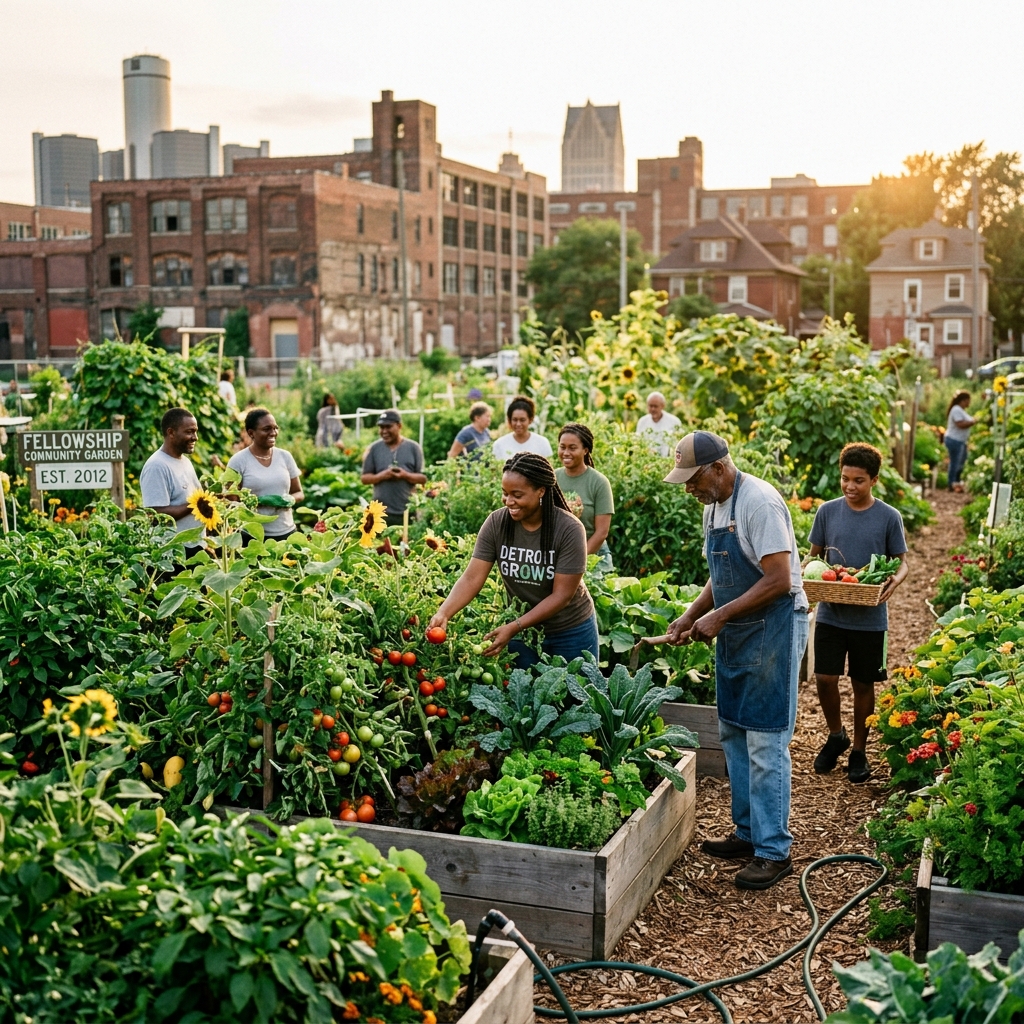
Detroit Cannabis Equity: Who Actually Benefits from Legalization?
Legalization was supposed to fix the damage. Six years in, only 3.8% of Michigan cannabis license holders are Black. Here's what's working, what's broken, and what comes next.
Questions this article answers
- does cannabis legalization help Black communities
- Detroit cannabis social equity program
- how many Black cannabis owners in Michigan
- what is a legacy operator in cannabis

Head Cultivator
On this page
Michigan legalized recreational cannabis in 2018. The promise was straightforward: end the arrests, open the market, and let the communities hit hardest by the War on Drugs finally benefit from a legal industry.
Six years later, the numbers tell a different story. Only about 3.8% of individuals with ownership interests in Michigan's licensed adult-use cannabis businesses are Black or African American. In a state where Black residents were arrested for marijuana at rates 3-4 times higher than white residents, that number isn't just disappointing — it's a structural failure.
This isn't a hit piece. At Divine Toke, we're a sun-grown organic cannabis farm rooted in Detroit, and we care deeply about the community we grow in. This article examines the social equity landscape honestly — what's been tried, what's working, what's broken, and what real equity might actually look like.
Table of Contents #
- What Is Cannabis Social Equity — and Why Does It Exist?
- The War on Drugs Left a Crater in Detroit
- How Michigan's Social Equity Program Works
- Detroit's Legacy Detroiter Program
- The Numbers Don't Lie: Who Actually Holds the Licenses?
- Why Social Equity Applicants Are Struggling
- Corporate Consolidation Is Making It Worse
- The 24% Tax Hit Equity Operators the Hardest
- What's Actually Working — Bright Spots in the System
- How to Support Equity in Cannabis Right Now
- FAQ: Cannabis Equity in Detroit and Michigan
- The Path Forward
What Is Cannabis Social Equity — and Why Does It Exist? #
Cannabis social equity is a framework built into legalization laws designed to ensure that communities disproportionately harmed by marijuana prohibition can participate in and benefit from the legal cannabis industry.
Social equity programs typically provide advantages such as:
- Reduced licensing fees for applicants from impacted communities
- Priority application processing to get equity licensees to market faster
- Technical assistance and training for business operations and compliance
- Access to funding or grants to offset the massive startup costs
- Expungement programs to clear cannabis-related criminal records
The logic is simple: if your community bore the brunt of cannabis criminalization for decades, you should have a meaningful seat at the table when that same plant becomes a legal, multi-billion-dollar industry. In Michigan, adult-use cannabis generated $3.17 billion in sales in 2025. The question is who gets to participate in that wealth.
The War on Drugs Left a Crater in Detroit #
Before we talk about today's equity programs, we need to talk about the damage they're trying to repair.
The War on Drugs, launched in the 1970s and intensified through the 1980s and 1990s, devastated Black communities across America — and Detroit was one of the hardest-hit cities in the country.
The impact wasn't just arrests. It was generational:
- Incarceration removed parents from homes, disrupting families and childhood stability
- Criminal records blocked access to jobs, housing, education, and bank loans for decades after release
- Asset seizure stripped families of property, vehicles, and savings — wealth that never came back
- Community disinvestment followed as neighborhoods labeled "high crime" lost businesses, services, and infrastructure
- Intergenerational trauma created cycles of poverty, distrust in institutions, and reduced economic mobility
The cruel irony is that cannabis use rates have always been roughly equal across racial groups. The enforcement, however, was not. Black Americans were 3 to 4 times more likely to be arrested for marijuana than white Americans — despite comparable usage rates. In some Michigan counties, that disparity was even higher.
The people who went to prison for selling a plant are now watching that same plant generate billions in legal revenue. Social equity programs exist because that contradiction demands a response.
How Michigan's Social Equity Program Works #
Michigan's social equity program, administered by the Michigan Cannabis Regulatory Agency (CRA), provides support to applicants who meet specific criteria tied to the impact of cannabis prohibition.
Who Qualifies? #
To be designated a Social Equity Applicant in Michigan, you must meet at least one of these criteria:
- Residency in a disproportionately impacted community — you've lived for at least 5 of the last 10 years in a community where cannabis arrest, conviction, or incarceration rates were higher than average
- Personal marijuana conviction — you have a past marijuana-related conviction that occurred before the November 2018 legalization
- Family impact — a close family member (parent, sibling, child, spouse) has a past marijuana conviction
What Benefits Do Equity Applicants Get? #
| Benefit | Standard Applicant | Social Equity Applicant |
|---|---|---|
| Application fee | Full price ($6,000-$40,000+) | 60% reduction |
| Annual license fee | Full price | 60% reduction |
| Processing priority | Standard queue | Prioritized review |
| Technical support | None | CRA-provided assistance |
| Grant eligibility | No | Yes (when funding available) |
The CRA also established the Racial Equity Advisory Workgroup to evaluate the program's effectiveness and recommend improvements.
Detroit's Legacy Detroiter Program #
Detroit created its own local equity layer on top of the state program — the Legacy Detroiter designation.
How It Works #
To qualify as a Legacy Detroiter, an applicant must prove they lived in Detroit for 15 of the last 30 years, OR for 13 consecutive years prior to application. During Detroit's initial licensing rollout starting in late 2022, the city reserved a portion of dispensary licenses exclusively for Legacy Detroiters.
The intent was clear: give longtime Detroit residents — many from communities devastated by drug enforcement — first access to the legal market before outside corporations could saturate the city.
The Reality #
The Legacy Detroiter program generated significant controversy:
- Predatory partnerships emerged, with well-funded outside investors offering to bankroll Legacy Detroiter applications in exchange for controlling ownership stakes — effectively using local residents as license holders while retaining financial control
- Verification challenges made it difficult to confirm residency claims, leading to disputes and delays
- Capital gaps persisted — even with a license, Legacy Detroiters often lacked the $500,000 to $2 million needed to actually build out and operate a dispensary
- Legal battles over licensing rules and allocation created uncertainty and stalled openings
Some Legacy Detroiters have succeeded in launching genuine, community-rooted businesses. But the program's structural weaknesses have left many others stuck — holding a license they can't afford to use, or locked into exploitative arrangements that undermine the equity the program was designed to create.
The Numbers Don't Lie: Who Actually Holds the Licenses? #
Michigan's cannabis industry demographic data reveals the scope of the equity gap:
- ~3.8% of ownership interests in licensed adult-use cannabis businesses are held by Black or African American individuals
- ~1.5% of ownership interests are held by Hispanic or Latino individuals
- Detroit is ~77% Black — yet many of the city's dispensaries are funded and ultimately controlled by non-resident investors
- The first annual decline in active cannabis licenses occurred in 2025, and smaller, undercapitalized operators (many of them equity licensees) were disproportionately affected
These numbers matter because they show that despite the programs, despite the fee reductions, despite the stated intentions — the legal cannabis industry in Michigan is overwhelmingly white-owned. The communities that paid the highest price during prohibition are receiving the smallest share of the legal market.
Why Social Equity Applicants Are Struggling #
The barriers aren't about willingness or capability. They're structural:
1. Capital Is King — and Equity Applicants Don't Have It #
Opening a licensed cannabis operation requires anywhere from $500,000 to $2 million or more in startup costs — including real estate, build-out, security systems, inventory, compliance infrastructure, and operating reserves.
Traditional banks won't lend to cannabis businesses (it's still federally complicated despite Schedule III movement). Private investors often demand controlling equity stakes. And the communities most impacted by the War on Drugs are, by definition, the ones with the least accumulated wealth — because the War on Drugs destroyed that wealth.
A 60% fee reduction on a $40,000 license fee saves $24,000. That's meaningful, but it's a fraction of the total cost. The license is the door, not the house.
2. Regulatory Complexity Is Crushing #
Michigan's cannabis regulatory framework is dense — compliance, testing, tracking, reporting, security, zoning, local ordinances. Navigating this system requires legal counsel, accounting expertise, and regulatory knowledge that costs money to acquire. Larger operators have compliance departments. Small equity operators are often doing it themselves.
3. The Market Is Brutal Right Now #
Michigan's cannabis market contracted in 2025 for the first time since legalization. Prices have dropped sharply due to oversupply. Established operators with deeper pockets can weather the storm. New and small operators — many of them equity licensees — are being squeezed out.
4. Timing Disadvantages #
Many social equity programs launched years after the initial licensing wave. By the time equity applicants were approved and operational, established players had already captured market share, built brand recognition, and locked down prime real estate.
Corporate Consolidation Is Making It Worse #
As the Michigan market matures, it's following the pattern seen in every state: corporate consolidation is accelerating.
Larger multi-state operators (MSOs) are acquiring struggling businesses, vertically integrating (controlling cultivation, processing, distribution, and retail), and leveraging economies of scale that small operators simply can't match.
For social equity operators, this creates a vicious cycle:
- Market oversupply drives prices down
- Lower prices mean lower margins for everyone
- Well-capitalized operators survive on volume; small operators can't
- Struggling equity operators sell their licenses to larger players
- The industry becomes more concentrated and less diverse
The result? Licenses that were supposed to represent community empowerment become exit strategies — sold to the very corporate entities that equity programs were designed to counterbalance.
The 24% Tax Hit Equity Operators the Hardest #
In January 2026, Michigan enacted a 24% wholesale tax on cannabis, stacked on top of existing excise and sales taxes. The combined tax burden now approaches 40% for industry operators.
While this tax affects everyone, it's disproportionately devastating for small, undercapitalized businesses — which are disproportionately equity operators. Here's why:
- Larger operators can absorb tax increases through volume, vertical integration, and operational efficiency
- Small operators with tight margins face a direct threat to survival
- Bipartisan repeal efforts (like Senate Bill 810) are underway, but legislative timelines are uncertain
- Consumer price increases may push more buyers to the illicit market, further reducing legal sales
For equity operators already on the edge, this tax isn't a burden — it's potentially a death sentence for their businesses.
What's Actually Working — Bright Spots in the System #
It's not all broken. Some elements of Michigan's equity approach are producing real results:
Expungement Programs #
Michigan's cannabis expungement laws have cleared tens of thousands of marijuana-related records, removing barriers to employment, housing, and lending. This is arguably the single most impactful equity measure — it directly restores opportunity to individuals harmed by prohibition.
Community-Rooted Operators #
Despite the challenges, some equity-backed businesses are thriving. They tend to share common traits:
- Genuine community ties — not just a license, but real relationships and local hiring
- Realistic scaling — starting small rather than trying to compete with MSOs on day one
- Craft differentiation — competing on quality, story, and transparency rather than price
- Partnerships with mission-aligned operators — collaborating with established cannabis businesses that share equity values rather than seeking to exploit them
Local Reinvestment Programs #
Some Michigan municipalities are directing cannabis tax revenue back into disproportionately impacted communities through infrastructure, education, and economic development programs. When implemented well, this creates a secondary equity pathway beyond direct business ownership.
The CRA's Racial Equity Advisory Workgroup #
The Workgroup continues to push for measurable reforms — including better data collection, accountability metrics, and program adjustments based on outcomes rather than intentions.
How to Support Equity in Cannabis Right Now #
You don't need a license to make a difference. Here's what consumers and community members can do:
As a Consumer #
- Buy from equity and community-rooted operators — ask your dispensary about their ownership and community involvement
- Ask about growing practices — operators who invest in organic, sun-grown cannabis are often more community-connected and mission-driven
- Support local over corporate — your dollars shape the industry. Every purchase at a locally-owned business strengthens the independent operator ecosystem
- Spread the word — tell friends and family about equity-rooted businesses in your area
As a Community Member #
- Support expungement clinics — volunteer or donate to organizations helping people clear cannabis records
- Advocate for tax reform — the 24% wholesale tax is disproportionately hurting small operators. Contact your state legislators
- Push for accountability — demand that social equity programs publish outcome data and adjust based on results
- Mentor and connect — if you have business, legal, or industry expertise, share it with aspiring equity operators
As an Industry Operator #
- Hire from impacted communities — equity isn't just about ownership, it's about jobs, training, and career pathways
- Partner fairly — if you're investing in an equity operation, structure deals that preserve genuine ownership and decision-making power for equity holders
- Share knowledge openly — the industry's complexity is a barrier. Transparency reduces it
At Divine Toke, we believe that growing clean cannabis in Detroit means growing something bigger than weed — it means growing opportunity. Our farm hires locally, sources locally, and reinvests locally. That's not a marketing angle. It's the whole point.
FAQ: Cannabis Equity in Detroit and Michigan #
Q: What is a social equity applicant in Michigan cannabis? #
A: A social equity applicant is someone who qualifies for reduced licensing fees and priority processing because they lived in a community disproportionately impacted by marijuana enforcement, have a past marijuana conviction, or have a close family member with one. The program provides a 60% reduction in application and licensing fees.
Q: What is a Legacy Detroiter in the cannabis licensing system? #
A: A Legacy Detroiter is someone who lived in Detroit for 15 of the last 30 years or 13 consecutive years. Detroit reserved initial dispensary licenses for Legacy Detroiters to give longtime residents first access to the legal market before outside investors.
Q: How many Black-owned cannabis businesses are there in Michigan? #
A: As of the most recent demographic data, approximately 3.8% of ownership interests in Michigan's licensed adult-use cannabis businesses are held by Black or African American individuals — despite Black residents making up about 14% of the state population and approximately 77% of Detroit's population.
Q: Why are social equity cannabis programs failing? #
A: The primary failure point is capital access. A 60% fee reduction saves $24,000 on licensing, but opening a dispensary costs $500,000 to $2 million or more. Without access to bank loans (which most cannabis businesses can't get) or non-exploitative investment, equity applicants can't bridge the gap between holding a license and operating a business.
Q: Does the 24% wholesale tax affect equity operators differently? #
A: Yes. The 2026 Michigan wholesale tax creates a combined ~40% tax burden on cannabis operators. Larger, well-capitalized companies can absorb this through volume and vertical integration. Smaller equity operators with tight margins are disproportionately threatened with closure.
Q: What is cannabis expungement in Michigan? #
A: Michigan allows people with certain marijuana-related convictions to have those records cleared (expunged). This removes barriers to employment, housing, and lending. Expungement is widely considered the most impactful equity measure because it directly restores opportunity to individuals harmed by prohibition.
Q: How can I tell if a dispensary is truly equity-owned? #
A: Ask directly about ownership structure, community involvement, and hiring practices. Look for locally-rooted operators who hire from the community, reinvest locally, and can tell you their story. Be cautious of businesses that use equity branding but are ultimately controlled by outside investors through partnership arrangements.
Q: How can consumers support cannabis equity in Detroit? #
A: Buy from community-rooted, locally-owned operators. Your purchasing decisions directly shape who thrives in the industry. Additionally, support expungement clinics, advocate for tax reform that protects small operators, and spread the word about equity-focused businesses in your area.
Q: Is federal rescheduling helping social equity? #
A: The April 2026 Schedule III reclassification for medical marijuana removes the 280E tax penalty, which helps all operators' profitability. However, it does not directly address social equity — the structural barriers of capital access, regulatory complexity, and market competition remain unchanged regardless of federal scheduling.
Q: What would real cannabis equity look like? #
A: Real equity would require direct capital investment (not just fee waivers), mandated ongoing demographic reporting with accountability measures, meaningful expungement with employment support, community reinvestment from tax revenue, and structural protections against predatory investment partnerships that strip equity holders of genuine ownership.
The Path Forward #
Cannabis legalization created an industry worth billions. The question was never whether there would be money — it was who would get to make it.
Right now, the answer in Michigan is: mostly not the people who paid the highest price during prohibition.
That can change. But it won't change through fee waivers and good intentions alone. It requires real capital access, structural protections for small operators, tax policy that doesn't crush undercapitalized businesses, and consumers who vote with their dollars every time they walk into a dispensary.
At Divine Toke, we're not here to lecture. We're here to grow great weed in Detroit, hire from our community, and prove that a cannabis business can be profitable AND equitable. That's the model we believe in.
The conversation isn't over. It's just getting honest.
Support Local — Shop Divine Toke →
This article is for educational purposes only. Divine Toke is a sun-grown organic cannabis farm rooted in Detroit, Michigan. Learn more about our community commitment and growing process.
Grown in Detroit. Shipped to your door.
Small-batch, sun-grown cannabis cultivated in living soil. Mail-order shipping to all 50 states.