The 2018 Hemp Farm Bill vs. the 2026 Farm Bill: What Every Consumer Needs to Know
A clear, comprehensive breakdown of how the new 2026 hemp law compares to the 2018 Farm Bill — and what it actually means for your favorite hemp products.
Head Cultivator
On this page
If you've been enjoying hemp-derived products over the past few years — whether that's a mellow delta-8 gummy after work, a smooth THCA pre-roll on the weekend, or your daily CBD tincture — you've probably heard some unsettling news. The rules are changing, and they're changing in a big way.
On November 12, 2025, President Trump signed H.R. 5371 (the Continuing Appropriations and Extensions Act of 2026), and tucked inside that spending bill was Section 781 — a provision that fundamentally rewrites the federal definition of hemp. The changes take effect November 12, 2026, giving the industry and consumers roughly a one-year runway before the landscape looks completely different.
This isn't a subtle tweak. For millions of everyday consumers, this is the most significant change to hemp law since the 2018 Farm Bill opened the floodgates in the first place. If you're shopping in Michigan — including Metro Detroit — federal hemp definitions are only half the story: the Cannabis Regulatory Agency (CRA) already sets rules for intoxicating cannabinoid products sold here. This guide is not legal advice; it's a consumer-facing breakdown of federal vs. Michigan marketplace reality.
Let's walk through everything — clearly, honestly, and without the hype — so you know exactly where things stand and what it means for you.
Table of Contents #
- A Quick History: The 2018 Farm Bill and How We Got Here
- The "Hemp Loophole" Explained
- How the Market Exploded (2018–2025)
- Enter H.R. 5371: What the 2026 Law Actually Says
- Side-by-Side: 2018 Farm Bill vs. 2026 Changes
- Product-by-Product Breakdown: What's Affected
- What Stays Legal After November 2026
- The State-by-State Patchwork
- How Enforcement Will Actually Work
- What the Hemp Community Is Saying
- Legislative Efforts to Save Hemp Access
- What You Can Do Right Now as a Consumer
- FAQ Section
1. A Quick History: The 2018 Farm Bill and How We Got Here #
To understand what's happening now, we need to rewind to December 2018 when the Agriculture Improvement Act — better known as the 2018 Farm Bill — was signed into law.
1.1 What the 2018 Farm Bill Did #
The 2018 Farm Bill removed hemp from the Controlled Substances Act. For the first time since prohibition began, hemp was federally legal. The law defined hemp as any part of the Cannabis sativa L. plant (including all derivatives, extracts, and cannabinoids) containing no more than 0.3% delta-9 THC on a dry-weight basis.
That definition was the whole ballgame. If your product came from cannabis and tested at or below that 0.3% delta-9 threshold, it was hemp — not marijuana — and it was legal.
1.2 The Original Intent #
Congress wasn't thinking about gummies, vapes, or smokable flower when they wrote the 2018 bill. The original goal was pretty straightforward: revive American hemp farming for industrial purposes — fiber, textiles, grain, biofuels, and non-intoxicating CBD wellness products. Senators like Mitch McConnell championed it as an agricultural opportunity, especially for farmers in states like Kentucky who needed new cash crops.
The motto among lawmakers at the time was essentially "rope, not dope."
1.3 The 2014 Pilot Program That Started It All #
The 2018 bill didn't come out of nowhere. The 2014 Farm Bill had already authorized limited pilot research programs, allowing universities and state agriculture departments to grow hemp experimentally. Those programs proved that hemp could be commercially viable, paving the way for full legalization four years later.
2. The "Hemp Loophole" Explained #
Here's where things got interesting — and where the everyday consumer's experience really began.
2.1 Why Delta-9 THC Was the Only Metric #
The 2018 Farm Bill defined legality based on one single measurement: delta-9 THC content. It didn't mention delta-8 THC, delta-10 THC, THCA, HHC, THC-O, or any of the dozens of other cannabinoids that can be derived from or found in the hemp plant. If it wasn't delta-9, it wasn't regulated.
This created what the industry calls the "hemp loophole."
2.2 The Rise of Delta-8 THC #
Chemists discovered they could take CBD (which hemp produces in abundance) and convert it through a relatively simple chemical process into delta-8 THC — a psychoactive cannabinoid that produces effects similar to traditional THC, just milder and smoother. Because the finished product contained less than 0.3% delta-9 THC, it was technically legal hemp under federal law.
Delta-8 started showing up everywhere: gas stations, smoke shops, convenience stores, online retailers. Suddenly, consumers in states without legal cannabis could access psychoactive hemp products with a simple online order.
2.3 THCA Flower: The Biggest Loophole of All #
THCA (tetrahydrocannabinolic acid) is the raw, acidic form of THC found naturally in cannabis plants. In its natural state, THCA is non-psychoactive — it doesn't get you high. But when you apply heat (smoking, vaping, cooking), THCA converts into delta-9 THC.
Here's the catch: compliance testing measures THC content before decarboxylation (before heat is applied). So a hemp flower bud could contain 20%+ THCA but still test below 0.3% delta-9 THC in its raw state. The result? THCA flower that was functionally identical to traditional marijuana became available as "hemp" in all 50 states.
2.4 The Courts Backed It Up #
In 2022, the Ninth Circuit Court ruled in AK Futures v. Boyd Street Distro that hemp-derived cannabinoids — including delta-8 — fell under the 2018 Farm Bill's protections. The court essentially confirmed that if it came from compliant hemp, it was legal, regardless of its psychoactive properties.
3. How the Market Exploded (2018–2025) #
The numbers tell the story of just how quickly this industry grew.
3.1 The CBD Boom #
Right after the 2018 Farm Bill, CBD was everywhere. U.S. hemp CBD sales hit roughly $4 billion by 2019 and climbed to $4.7 billion by 2020. Every wellness brand, pharmacy chain, and Instagram influencer was talking about CBD oil, gummies, and topicals.
3.2 The THC Alternative Surge #
As the CBD market matured and margins tightened, hemp-derived THC products took center stage. Delta-8, delta-10, HHC, and THCA products surged from about $200 million in 2020 to over $2.8 billion by 2023 and approximately $3.5 billion by 2024.
3.3 A $28–30 Billion Industry #
By 2025, the total hemp-derived cannabinoid market (including CBD, THC alternatives, and wellness products) was estimated at $28–30 billion annually, supporting roughly 300,000 jobs across farming, processing, distribution, retail, and ancillary services.
That's the industry that's now facing a fundamental rewrite of the rules.
4. Enter H.R. 5371: What the 2026 Law Actually Says #
Let's get into the specifics of what's actually changing. No rumors, no speculation — just what the law says.
4.1 The New Definition of Hemp #
Section 781 of H.R. 5371 amends the 2018 Farm Bill's definition of hemp in three critical ways:
Total THC, Not Just Delta-9: Hemp is now defined as cannabis with no more than 0.3% total THC (including THCA, delta-8, delta-10, and all other THC variants) on a dry-weight basis for raw plant material.
Finished Product Cap: Consumer-ready products (edibles, tinctures, vapes, beverages, etc.) cannot exceed 0.4 milligrams of total THC per innermost container, regardless of size.
Synthetic and Converted Cannabinoid Ban: Cannabinoids that are synthetically manufactured or chemically converted from other cannabinoids (like delta-8 from CBD) are explicitly excluded from the definition of hemp.
4.2 The 0.4mg Cap — Let That Sink In #
To put the 0.4mg per container limit in perspective: a typical hemp delta-9 gummy contains 5–25mg of THC per piece, and packages often contain 10–30 pieces. Under the new law, an entire package of gummies cannot exceed 0.4mg total. That's roughly 1/12th of a single current low-dose gummy.
This isn't a regulation — it's effectively an elimination.
4.3 Specifically Banned Cannabinoids #
The law targets three categories:
- Synthetic cannabinoids: HHC, THC-O, THCP, and anything manufactured in a lab rather than extracted from the plant
- Converted cannabinoids: Delta-8 THC, delta-10 THC, and others created by chemically converting CBD or other hemp-derived compounds
- High-THCA products: Any flower or extract that exceeds the 0.3% total THC threshold when THCA is factored in
The FDA was tasked with publishing a definitive list of natural cannabinoids, THC-class compounds, and substances with THC-like effects within 90 days of the law's signing (by February 2026), though that list has been delayed.
4.4 The Effective Date #
All of these changes take effect on November 12, 2026 — exactly one year after the bill was signed.
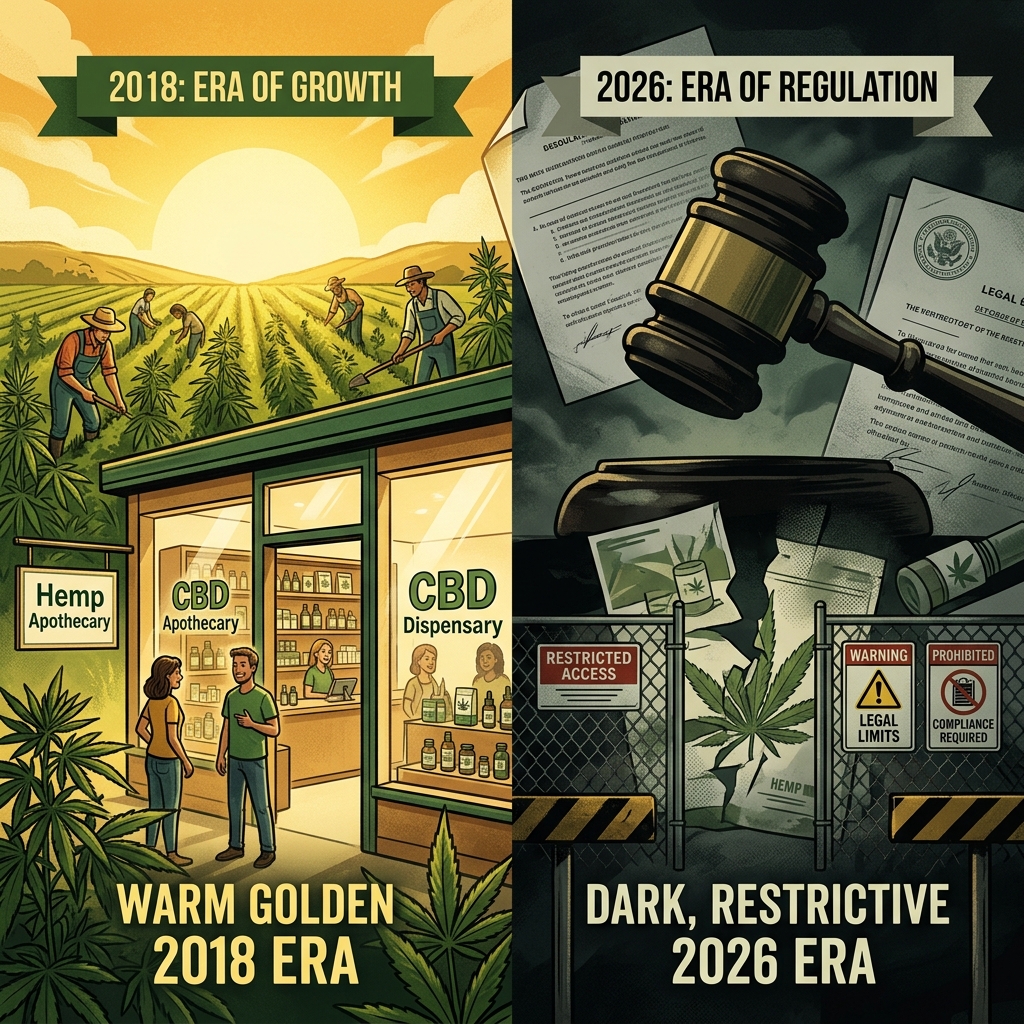
5. Side-by-Side: 2018 Farm Bill vs. 2026 Changes #
Here's the clearest way to see what's different:
| Category | 2018 Farm Bill | 2026 Changes (H.R. 5371) |
|---|---|---|
| THC Measurement | Delta-9 THC only | Total THC (all forms including THCA) |
| Plant Material Limit | ≤0.3% delta-9 THC (dry weight) | ≤0.3% total THC (dry weight) |
| Finished Product Limit | No specific limit beyond plant compliance | ≤0.4mg total THC per container |
| Synthetic Cannabinoids | Not addressed (legal by omission) | Explicitly banned |
| Converted Cannabinoids | Not addressed (legal by omission) | Explicitly banned |
| THCA Flower | Legal (tested pre-decarboxylation) | Illegal (total THC includes THCA) |
| Non-Intoxicating CBD | Legal | Still legal if truly low-THC compliant |
| Industrial Hemp | Legal | Still legal (fiber, grain, seed) |
6. Product-by-Product Breakdown: What's Affected #
Let's get specific about the products you might be using right now.
6.1 Delta-8 THC Vapes and Edibles — Gone #
Delta-8 is created by chemically converting CBD. Under the new law, converted cannabinoids are explicitly excluded from the definition of hemp. Delta-8 products will be federally illegal regardless of their THC content. Period.
6.2 THCA Flower and Pre-Rolls — Gone #
This is the big one for flower enthusiasts. THCA flower has been the closest legal equivalent to traditional cannabis in non-legal states. Under total THC testing, virtually all THCA flower will exceed the 0.3% threshold. If you've been enjoying THCA pre-rolls or flower, federal law will no longer consider them hemp after November 2026.
6.3 Hemp-Derived Delta-9 Edibles — Gone #
Those compliant delta-9 gummies that kept each piece under 0.3% THC by weight? The new 0.4mg per container cap makes them impossible. A single gummy with 5mg of THC exceeds the entire container limit by more than 12 times.
6.4 HHC, THC-O, Delta-10, THCP — Gone #
All synthetic and converted cannabinoids are banned outright. HHC (hexahydrocannabinol), THC-O (THC-O-acetate), delta-10 THC, and THCP are all explicitly excluded.
6.5 CBD Isolate and Low-THC Topicals — Still Legal #
Pure CBD products — isolates, broad-spectrum extracts with non-detectable THC, and topicals — should remain compliant as long as they contain no more than 0.4mg total THC per container. If you're using CBD strictly for wellness without any psychoactive intent, your products are likely safe.
6.6 Full-Spectrum CBD — It Depends #
Full-spectrum CBD products contain trace amounts of various cannabinoids, including small amounts of THC. Whether these survive depends entirely on whether they can stay under that 0.4mg total THC container cap. Many will need to be reformulated.
6.7 Industrial Hemp Products — Unaffected #
Hemp fiber, hemp seed oil, hemp protein, hemp clothing, hemp building materials — none of these are affected. The law continues to support industrial hemp agriculture. It's the cannabinoid consumer market that's being reshaped.
7. What Stays Legal After November 2026 #
It's easy to read all of this and feel like everything is disappearing. Let's be clear about what remains:
- CBD isolate products with negligible THC
- Broad-spectrum CBD (THC-free formulations)
- Hemp seed oil and hemp-based food products
- Hemp fiber products (clothing, rope, building materials)
- Topical CBD products under the THC cap
- CBG, CBN, and other non-THC cannabinoids (provided they aren't synthetically derived or converted, and don't trigger the THC-like effects clause)
The wellness side of hemp isn't going away. But the products that many consumers relied on for accessible, affordable relief — particularly in states without legal cannabis — those are the ones facing the chopping block.
8. The State-by-State Patchwork #
One thing that hasn't changed is that states can set their own rules. Some states were already ahead of the federal government in restricting hemp products, while others may choose to be more permissive.
8.1 States That Already Restricted Hemp #
Several states didn't wait for federal action:
| State | Action Taken |
|---|---|
| Ohio | Banned most hemp THC products via SB 56 (effective March 2026); lawsuits ongoing |
| Arkansas | Restricted intoxicating hemp products |
| Louisiana | Banned most intoxicating hemp products in 2024 |
| California | Restricted hemp inhalables via AB 8 (January 2026); non-inhalables still available |
| Idaho, Iowa, South Carolina | Banned smokable hemp before federal changes |
8.2 States That Remain Hemp-Friendly (For Now) #
| State | Current Status |
|---|---|
| Illinois | Hemp products available through regulated market |
| Minnesota | Regulated THC edibles and beverages allowed |
| Wisconsin | Products remain available short-term |
| Colorado | Products available, monitoring federal changes |
8.3 Michigan: CRA Rules Already Shape the Shelf #
Michigan didn't wait for the 2026 federal rewrite to rein in intoxicating hemp cannabinoids. Effective October 11, 2021, the state brought all THC products derived from the cannabis plant — including delta-8 THC — under Marijuana Regulatory Agency / CRA regulation, per the agency's October 2021 bulletin. That same notice made clear those products would no longer be available in convenience stores, gas stations, and tobacco/smoke shops the way they had been.
For Detroit consumers and Michigan retailers, the practical takeaway is simple: even while the 2018 Farm Bill's federal hemp definition stayed wide open elsewhere, Michigan already treated many intoxicating hemp THC products as regulated marijuana. Federal H.R. 5371 will tighten the national floor in November 2026 — but shoppers here still have to follow CRA-licensed channels and state product rules today. Pending Michigan hemp bills may refine that framework further; watch the CRA and Michigan Legislature for updates. None of this is legal advice.
8.4 The Key Takeaway #
After November 2026, federal law sets the floor. States can be stricter, and some may attempt to be more permissive, but selling products that violate federal definitions carries real legal risk — especially for interstate commerce and online sales. In Michigan, CRA licensing and testing already sit on top of whatever federal hemp definition is in force.
9. How Enforcement Will Actually Work #
This is the question on everyone's mind: Will police actually come after consumers?
9.1 The Honest Answer #
There is no specific mandate in H.R. 5371 directing local law enforcement to arrest hemp consumers. The law redefines what counts as hemp — it doesn't create new policing initiatives targeting individual users.
However, products that no longer qualify as hemp under the new definition would technically be reclassified as marijuana (a Schedule I controlled substance under the CSA). That means possession could theoretically be treated the same as marijuana possession under federal law.
9.2 DEA and FDA Resources #
A Congressional Research Service report has noted that the DEA and FDA have limited resources for broad consumer-level enforcement. The primary enforcement targets will likely be manufacturers, distributors, and retailers — not the person with a pack of gummies in their nightstand.
9.3 Interstate Commerce Is the Real Risk #
Where enforcement will hit hardest is in the supply chain. Online retailers shipping across state lines, wholesalers distributing non-compliant products, and manufacturers continuing to produce banned items will face the most scrutiny. If you're ordering hemp products online, that pipeline may dry up well before November 2026 as businesses adjust.
9.4 The Hemp-Marijuana Confusion Problem #
Law enforcement already struggles to distinguish hemp from marijuana — they look and smell identical. This confusion has led to wrongful arrests and seized shipments even under the more permissive 2018 framework. Without clear field-testing solutions for total THC, enforcement at the street level will remain messy and inconsistent.
10. What the Hemp Community Is Saying #
The reaction from the hemp community — from consumers to farmers to industry leaders — has been vocal and passionate.
10.1 Industry Leaders Sound the Alarm #
Hemp industry advocates have been making the rounds on Capitol Hill and across media platforms. Popular YouTube explainers like "Hemp Ban 2026 Update | What Happens to CBD, Delta-8, THC-A?" have broken down Section 781 for everyday viewers, noting that roughly 95% of hemp products currently on the market will become federally non-compliant by November 2026.
Another widely-viewed video, "The 2026 Hemp Ban: Delta-8, THCA, HHC… ALL GONE?" detailed how the provision was quietly inserted into a government spending bill, affecting millions of Americans, farmers, small businesses, and veterans who rely on these products.
10.2 The Jobs and Economic Impact #
Industry groups estimate that up to 300,000 jobs are directly at risk — spanning farming, extraction, manufacturing, retail, and distribution. The $28–30 billion market that grew from the 2018 Farm Bill faces a dramatic contraction.
10.3 Farmer Uncertainty #
Hemp farmers face a particularly difficult situation. Those who planted crops for cannabinoid extraction may find their harvest reclassified as a controlled substance before they can bring it to market. The uncertainty has already chilled 2026 planting decisions in many states.
10.4 Consumer Frustration #
For consumers — especially those in states without legal cannabis programs — hemp products represented accessible, affordable relief for pain, anxiety, sleep, and general wellness. Many feel that the ban prioritizes pharmaceutical and licensed cannabis industry interests over consumer choice.
11. Legislative Efforts to Save Hemp Access #
The story isn't over. Several pieces of legislation are actively working through Congress to either delay or replace the ban with a regulated framework.
11.1 The HEMP Act #
The Hemp Enforcement, Modernization and Protection Act — introduced by Representatives Morgan Griffith (R-VA) and Marc Veasey (D-TX) — proposes an FDA-regulated framework for hemp-derived products. Key provisions include:
- Age restrictions (21+)
- Labeling and testing requirements
- THC serving limits of 5mg per serving / 30mg per package (if FDA delays rulemaking)
- A ban on truly synthetic cannabinoids while preserving naturally-derived ones
This is the most comprehensive alternative currently on the table.
11.2 The Hemp Planting Predictability Act #
H.R. 7024, introduced by Representative Jim Baird, would simply delay the ban by two years — pushing the effective date to November 2028 — to give the industry time to adapt and Congress time to develop a proper regulatory framework.
11.3 The Cannabinoid Safety and Regulation Act (CSRA) #
Senators Wyden and Merkley introduced this bill proposing federal rules including:
- 21+ age minimum for purchase
- 5mg THC per serving limits
- Mandatory testing and labeling
- A ban on dangerous synthetics (like K2/Spice) while preserving plant-derived cannabinoids
11.4 Bipartisan State Opt-Out Proposal #
A bipartisan Senate bill would allow individual states and tribal nations to opt out of federal restrictions by filing notice with the USDA, provided they implement their own age requirements and consumer protections.
11.5 Industry Lobbying #
The U.S. Hemp Roundtable held over 100 meetings on Capitol Hill in January 2026 alone. Hemp Industry and Farmers of America (HIFA) has deployed significant lobbying resources, including multiple registered lobbyists and monthly six-figure advocacy budgets. The message is consistent: regulate, don't prohibit.
12. What You Can Do Right Now as a Consumer #
You're not powerless in this. Here's what you can practically do:
12.1 Stay Informed #
Follow the legislative developments. The HEMP Act, the Baird delay bill, and the CSRA are all still moving. Outcomes are not set in stone.
12.2 Contact Your Representatives #
The hemp industry's lobbying efforts are significant, but elected officials respond to constituent voices. A phone call or email to your House representative and Senators expressing support for regulated hemp access (rather than outright prohibition) carries real weight.
12.3 Know Your State Laws #
Your state may offer protections that the federal government doesn't. If you're in a state with legal cannabis, those programs remain fully intact. If you're in a hemp-friendly state like Minnesota or Illinois, regulated markets may continue to operate. Michigan shoppers should treat licensed dispensaries and CRA consumer resources as the baseline — gas-station delta-8 was already outside the legal path here after October 2021.
12.4 Understand What You're Buying #
As November 2026 approaches, the market will shift. Some retailers may try to clear inventory with aggressive sales. Others may begin reformulating products to stay compliant. Look for transparency — companies that publish third-party lab results (COAs) and clearly label their products are the ones worth supporting.
12.5 Consider the Transition #
If you rely on hemp-derived THC products for wellness, start exploring your options now. That might mean looking into your state's medical cannabis program, switching to compliant CBD products, or supporting legislative efforts that would preserve regulated access.
FAQ Section #
Q: Is CBD still legal after November 2026? #
A: Yes — as long as it's truly low-THC. CBD isolate products, broad-spectrum CBD, and topicals that contain no more than 0.4mg total THC per container remain compliant under the new law. Full-spectrum CBD products may need to be reformulated.
Q: Will I get arrested for having hemp products after the deadline? #
A: The law doesn't create new policing mandates targeting individual consumers. However, products that no longer qualify as hemp would technically be classified as controlled substances. Enforcement will likely focus on manufacturers and retailers, not individual users, but the legal risk exists.
Q: What about the delta-8 I already have at home? #
A: Existing products you've already purchased won't trigger a door-knock from the DEA. The enforcement focus will be on the supply chain — manufacturing, distribution, and retail sales. That said, possessing what is legally reclassified as a controlled substance does carry theoretical legal risk.
Q: Can states override the federal ban? #
A: States can set their own rules, but they cannot make something federally legal that the federal government has made illegal. Some states may choose not to enforce federal hemp restrictions, similar to how many states handle recreational cannabis. A bipartisan Senate proposal would allow states to formally opt out.
Q: What about Michigan and Detroit shoppers right now? #
A: Federal Farm Bill changes set a national definition of hemp, but Michigan already regulates intoxicating THC products — including delta-8 — through the CRA. Buying through licensed channels and reading current CRA guidance matters more for Detroit-area consumers than waiting on the November 2026 federal effective date alone. This is not legal advice.
Q: What's the difference between "total THC" and "delta-9 THC"? #
A: Delta-9 THC is one specific form of THC. Total THC includes delta-9 plus all other THC variants — THCA, delta-8, delta-10, and others. The 2018 Farm Bill only measured delta-9. The new law measures everything combined, which is why THCA flower and delta-8 products can no longer qualify.
Q: Are hemp edibles completely gone? #
A: Any edible exceeding 0.4mg total THC per container is non-compliant. Since most current hemp edibles contain 5–25mg per piece (with multiple pieces per package), virtually all existing hemp THC edibles will be eliminated. Non-THC hemp edibles (like CBD-only gummies) may survive if reformulated.
Q: What happens to hemp farmers? #
A: Farmers growing hemp for fiber, grain, and seed are largely unaffected. Farmers growing high-cannabinoid hemp for extraction face significant uncertainty. Crops intended for THC-adjacent products may become non-compliant before reaching market. Several bills in Congress aim to provide farmers with transitional support.
Q: Will hemp flower still be available to smoke? #
A: Hemp flower with negligible total THC (truly below 0.3% including THCA) could technically remain legal, but such strains produce minimal cannabinoid effects. The THCA-rich flower that most consumers purchase for smoking will no longer qualify as hemp.
Q: When exactly does this take effect? #
A: November 12, 2026 — exactly one year after H.R. 5371 was signed into law. Some provisions may see delayed enforcement (USDA has indicated potential delays to December 2026 for some agricultural rules), but the statutory effective date is firm.
Q: Is there still hope for keeping hemp products legal? #
A: Yes. Multiple bills are actively moving through Congress — the HEMP Act, the Hemp Planting Predictability Act, the CSRA, and a bipartisan state opt-out proposal. Industry lobbying is intense, and there's genuine bipartisan interest in regulation over prohibition. The outcome is still being written.
Conclusion #
The shift from the 2018 Farm Bill to the 2026 changes under H.R. 5371 represents the most significant rewriting of hemp law in modern American history. What started as an agricultural revival act became the foundation for a $30 billion consumer industry — and now that foundation is being rebuilt from the ground up.
For everyday consumers, the practical impact is real: most of the hemp-derived products you've come to know and rely on will no longer be federally legal after November 12, 2026. Delta-8 vapes, THCA flower, THC gummies, HHC edibles — they're all on the chopping block. Michigan and Metro Detroit shoppers should also remember the local layer: CRA rules already shape what can be sold here, separate from the federal hemp rewrite.
But this isn't a done deal carved in stone. The legislative process is alive with alternatives — from regulated market proposals to delay bills to state opt-out provisions. The hemp community is organized, vocal, and showing up.
What matters most right now is staying informed, making your voice heard, and understanding your options. Whether that means supporting the HEMP Act, exploring your state's cannabis program, or simply knowing what's in the products you use — knowledge is your best tool.
At Divine Toke, we'll keep following this story and keeping you in the loop. This is your community, and these are your choices. We're here to make sure you have the information to navigate whatever comes next.
Stay grounded. Stay informed. Stay elevated.
Grown in Detroit. Shipped to your door.
Small-batch, sun-grown cannabis cultivated in living soil. Mail-order shipping to all 50 states.